
- Published on
What your voice sounds like on different planets
- Authors

- Name
- FeelTheShock
- @FeelTheShock
In this exploration, we're going to send you to each of the planets in the solar system, starting with the smallest world and ending with the enormous gas giants. Let's see if anyone can hear you scream.
Mercury: The Silent World
Okay, we'll start with the closest planet to our sun, Mercury. It's an odd world. You see, Mercury might be the closest to the sun, but it's not even the hottest planet. Don't get me wrong, it's still scorching during the day with temperatures going up to 427°C. But at night, you see the temperatures drop to -79°C. And those nights on Mercury are long. They last for three Earth months.
The reason why the temperature has such a wide range is the atmosphere, or specifically the lack of it. Yeah. Instead of a full atmosphere like we have on Earth, well, Mercury has a thin exosphere. There's some oxygen in it along with sodium, hydrogen, helium, and potassium, but you couldn't breathe it.
If you were born on Mercury, well, you'd have a stocky build and a thick layer of fat under your metallic looking skin to help you do some internal temperature control. But still, you couldn't breathe here. Not in this exosphere. And if you couldn't breathe, well, you couldn't scream on Mercury either.
The Sound of Silence
No matter how hard you scream on Mercury, no one will hear you. And not only because there's no one else around you. The thing is, sound needs a medium to travel through. And being on Mercury is practically the same as being in the vacuum of space. Its extremely thin exosphere is just wisps of atoms. The vibrations of your vocal cords would have no air to carry them. So your voice wouldn't travel at all.
Mercury is a quiet, scorching hot and frigid cold world. But there's still one way you can hear things on it. You'd have to press your ear to the ground during a Mercury quake. A Mercury quake is like an earthquake, just on Mercury. If you put your ear to the ground, you'd hear the vibrations of the planet like a deep, deep rumble. But that wouldn't stay there too long, though. It's still a quake, and shaking ground could cause all kinds of havoc.
Mercury is a place of extremes and a silent one at that.
Venus: The Deep Bass Planet
So, let's move on to a planet that has an extremely thick atmosphere. Out of all the rocky planets in the inner solar system, Venus has the densest, most terrifying atmosphere. And sounds are booming here, literally.
How Your Ears Work
But before I tell you exactly how you would sound on Venus, I'm going to take you on a journey inside your ear. Your human ears evolved on Earth to detect and interpret sound waves in Earth's air.
You have an outer ear. That's the part of your ear that you can see. This is the part that gathers the sound waves. Inside, you've got a middle ear. It has ossicles, which are the tiniest bones in your body. They amplify the vibrations that your outer ear detects. And then there's the inner ear. Here you've got the cochlea. It's a spiral-shaped organ that's filled with fluid. Now, when sound vibrations reach it, the fluid inside the cochlea moves and triggers tiny nerve endings. Then, these nerves turn the vibrations into electrical signals that travel to your brain. That's how you hear.
Hey, fun fact. Some parts of your ears evolved from fish. Yeah. One of the tiny bones in your middle ear, the stapes, evolved from an ancient fish's gill. And the other two, the malleus and the incus, were once part of the jaw in your ancient reptile-like ancestors. It took millions of years of evolution for these bones to detach into the middle ear. All so that you can hear things all around you.
Venus: Extreme Conditions
You didn't evolve to hear things on Venus where the conditions are beyond extreme. Because Venus has this much air, it traps the sun's heat. So, this world is hot. Extremely hot. But the atmosphere isn't just creating heat. It makes a lot of pressure on the surface, too. Standing on Venus would be like being crushed by the ocean at 1 kilometer below sea level. The weight of this extreme atmosphere above you would crush down with about 90 times the air pressure you're used to on Earth.
You'd need a very strong bone structure to survive here. And your skin would look metallic to reflect all that boiling heat and protect you from radiation.
Your Voice on Venus
So what would this Venusian you sound like? Like a deep booming growl. Yeah, like that. In this gassy soup of Venus's air, your pitch would be extremely low. Imagine speaking through a scuba tank and multiply it by a lot. It would be a pretty funny thing to see. On Venus, you'd evolve way shorter than you are on Earth, but your voice would sound as if you were a giant. You'd be a tiny person with a rumbling bass.
And that's not all the Venusian atmosphere would do to your voice. You see, sound on Venus travels faster than it does on Earth. You're used to the speed of sound at 340 m/s. On Venus, it speeds at 410 m/s. So, what does that mean for your voice? Well, because the sound here travels faster, it would make some frequencies of your voice higher. The overall tone would still be bassy. So you'd have a slightly distorted booming voice. You'd sound like Donald Duck on bass, something like that.
That means your ears would have to evolve here, too. On Earth, you're tuned into higher frequencies of your environment. But on Venus, your ears would have to focus on catching lower tones. And you'd need to catch the bassy lightning in the sky. Yeah, the environment around you would sound bassy as well.
Your ears would be different here. You'd have a tiny outer ear, but your eardrums would be thicker and less flexible so that they can withstand constant pressure. You might even evolve to have chambers filled with fluid instead of air cavities, similar to what crocodiles have.
The problem is though, you still couldn't breathe here. The Venusian atmosphere is mostly carbon dioxide. So if you wanted to not constantly depend on oxygen tanks, you better evolve to breathe all that CO2.
Mars: The Muffled World
Okay, now let's hear you screaming on Mars. Hey, if you ever wanted to be tall, well, welcome to Mars. To survive in this lower gravity, non-breathable atmosphere, low temperature environment, you'd evolve to be tall and lean. Yeah, gravity on Mars is only 38% of Earth's gravity. So, walking here would feel much easier for you, which is not what I can say about screaming.
Mars is doing better than Mercury in the air department, but it's still nowhere near Earth. The atmosphere here is thin and mostly carbon dioxide. So even if you screamed at the top of your lungs, the sound would come out muffled and quiet. This very thin atmosphere wouldn't carry the sound waves like it does on Earth. The loudest scream ever would sound like a quiet whisper, and you'd have to be within a few meters from the source of this sound just to be able to hear it.
Your lungs would also need to evolve to be super lungs so that you could extract whatever little oxygen there is in the air.
Sound Quality on Mars
Now, unlike on Venus, the speed of sound on Mars is lower, reaching only 240 m/s. Not because the air is thin, but because it's very cold here. Hey, you'd be trying to survive in a temperature range from a comfortable 20°C (70°F) to freezing cold minus 153°C (-225°F).
For your voice, it means you would have a lower pitch. At the same time, the low density carbon dioxide rich atmosphere would be absorbing higher frequencies. So your voice would be quiet and deep. Not as deep as on Venus, but deeper than it is on Earth. On Mars, you'd sound as if you were speaking through a wall with a thick mask on.
And if you're trying to listen to someone with a high-pitched voice, well, you definitely need a hearing aid. Yeah, your earthly ears are not designed to hear well on Mars in the near vacuum environment.
Jupiter: The Squeaky Giant
But things would be very different on Jupiter. Now, Jupiter is one planet that doesn't have an issue with near vacuum-like air. It's a gas planet, a gas giant even. It doesn't have a solid surface you could step on. So, for one, you'd have to live in the cloud habitat.
In the cloud tops, the atmospheric pressure is just like on Earth. It would be a perfect spot for you to evolve. The atmosphere around you would be a mix of hydrogen and helium. And it would be chilly. I should say extremely chilly. Minus 110°C. That's -166°F.
Now, having evolved on Jupiter, well, you'd have less bone density and build more muscle. You'd have dark skin to protect you from the intense radiation on this planet.
Jupiter's Helium Voice
But what about your voice? Well, it's not what you would think. Sure, Jupiter has all this gas, and after the thick Venusian atmosphere, you might think your voice would be deep and bassy, but it wouldn't be like that on Jupiter. Here, you'd sound more like this, like a stocky little chipmunk.
That's because the air here in the cloud tops is very light and has helium in it. A sound here travels three times faster than it does on Earth. Thanks to all the light hydrogen and helium, your vocal cords would vibrate with less resistance and your pitch would shift up.
Of course, you'd have a problem breathing. There's no oxygen on Jupiter, so you'd have to evolve into a hydrogen breathing being if you wanted to scream on Jupiter without a helmet. But if you could breathe and scream here, your squeaky voice would be loud and it would travel very far.
Of course, it would have to compete with the roar of Jupiter. This gas giant is loud. It has intense storms and massive lightning booming and echoing all around the planet. You'd have to yell very loudly to outscream Jupiter itself.
Saturn: Squeaky Winds
But what about Jupiter's gas cousin, Saturn? Okay, like Jupiter, Saturn has a hydrogen helium atmosphere, too. And the temperature in the cloud tops drops to -140°C (-220°F). It's no surprise that your voice on this giant planet would also be high pitched. It would travel fast and far competing with Saturn's winds.
Yeah, winds here can get intense. Jet streams are pushing 1,800 km/hour. That's 1,100 mph and storms are happening everywhere. Saturn itself sounds like a methane laden whoosh with deep thunderclaps within its clouds.
Luckily, storms on Saturn aren't as intense as those on Jupiter. So on a calm day, you could talk to someone in your comically squeaky voice if you're close enough to them, but you still couldn't breathe here unless you grew specialized organs that would help you synthesize breathable oxygen from water vapor in Saturn's clouds.
Uranus: The Smelly Ice Giant
Now, moving on to the far reaches of the solar system, we have Uranus. This is a cold place in the upper clouds. You'd be battling to survive in minus 200°C air. That's minus 330°F. And it's not like it's breathable air.
Just like Jupiter and Saturn, Uranus has an atmosphere of hydrogen and helium. But it also has quite a lot of methane. If you could somehow breathe and scream in this environment, you'd have a high-pitched voice, but not quite as squeaky as the one on those gas giants.
That's because the atmosphere of Uranus is colder and a bit less dense in the cloud tops than Earth's atmosphere. And like I mentioned, it has methane, which is a heavier gas than helium or hydrogen. Now, because of all that, the speed of sound on Uranus is lower than on Jupiter, but it would still carry your chipmunk screams a long way.
And Uranus is way quieter than Jupiter. Sure, it has winds speeding at 900 km/h in some areas, but overall the weather here isn't as intense. As far as ice and gas giants in the solar system go, Uranus is pretty bland.
But it stinks horribly. Yeah, thanks to hydrogen sulfide in its upper atmosphere, this planet reeks of rotten eggs. If you can scream and breathe, you can smell, too. And you'd be smelling this.
Neptune: The Howling World
Okay, let's have you scream on the last big planet of the solar system, Neptune. All right, Neptune is the second ice giant of our neighborhood, and it is extreme. To be fair, all the gas and ice giants are extreme, but Neptune is off the charts extreme.
So, Neptune has a similar atmosphere to Uranus, but the weather here would knock your socks off. Neptune is famous for its enormous winds, blowing at over 2400 km/h (1,500 mph). They whip you around and whip your habitat around, and you wouldn't know where you were, but you could still scream here.
Your voice would sound high-pitched, the same chipmunk voice you'd have on Jupiter, Saturn, and Uranus. Only nobody would ever hear you over all that background howling sound. Yeah, Neptune is loud. Fast winds all over the planet would create a constant roar of turbulent storms. Here, you would hear loud whooshes of wind all the time. Your tiny high-pitched voice will be lost in those deafening howls.
The Cosmic Voice Conclusion
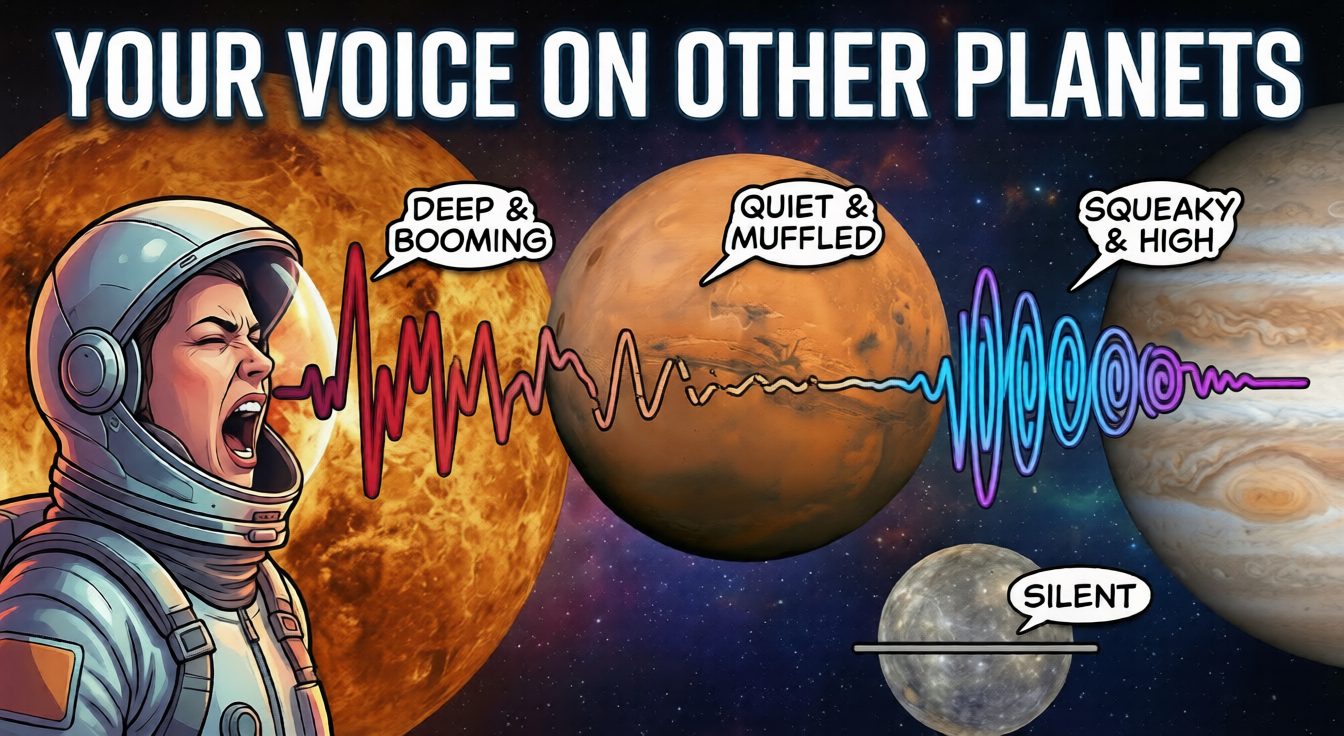
So there you have it. Gas and ice giants make you sound squeaky. Venus turns your voice to bass. And Mars and Mercury just prefer if you stay quiet.
Now surviving these planets would be tough, but you could try if you're feeling optimistic. But that's a story for another shock.