
- Published on
What If You Lived on Mars 1 Billion Years Ago?
- Authors

- Name
- FeelTheShock
- @FeelTheShock
Scientists have finally discovered potential signs of life on Mars. To fully understand what they've found and what this discovery means, let me take you back in time. But I'm not just going to take you back 1 billion years. We're going to start much, much further back in history.
Billions of years ago, Mars wasn't a simple lifeless red rock. It had a thick atmosphere, pleasant temperatures, and liquid surface water. Think beachfront property. Back then, Mars might have been a better location for life to take hold than Earth. And maybe it did have living organisms on it.
The Birth of Mars: Pre-Noachian Period (4.5 Billion Years Ago)
So, let's start at the beginning. And by that I mean the beginning of the planets in our solar system around 4.5 billion years ago. On Mars, this period is known as the Pre-Noachian. Mars had just formed from dust and gas in the protoplanetary disc just like Earth did. Pieces of debris clumped into a planet with a dense core, a rocky mantle, and a crust. And this planet was slammed with swirling space rocks.
In its early years, Mars had a very dense atmosphere and an ocean so big it covered one-third of the planet. At first, the planet was super hot, but slowly between 4.3 and 4.4 billion years ago, it cooled down.
The Noachian Period: Mars at Its Most Habitable (4 Billion Years Ago)
Fast forward to the Noachian period about 4 billion years ago. This was a time of heavy asteroid and comet bombardments and widespread volcanic activity. So basically everything that could blast gas, vapor, and dust into the atmosphere was doing it. It was a perfect place for life to put down roots.
All these gases created a thick atmosphere, and the planet heated up thanks to the good old greenhouse effect. Suddenly, Mars had clouds, valleys, lakes, and even rain. Likely acid rain. And this acid rain wasn't just destructive—it may have been useful. As it dissolved Martian rocks, it released minerals and nutrients into rivers and lakes, providing a chemical buffet for any microbes trying to survive.
Not harsh for you, but a probable paradise for tiny alien life.
The Beginning of the End: Loss of the Magnetic Field
Then somewhere between 4.1 and 3.7 billion years ago, things started going downhill. The interior of Mars cooled off and its magnetic field dissipated. Now, that's a problem for life. You might not think about magnetic fields very often, but without them, planets die.
That's because without a magnetosphere, nothing is protecting the planet from solar wind. And that wind strips planets of their atmosphere.
How Solar Wind Destroys Atmospheres
How does it do it? Well, solar wind isn't like the wind you know. It's a stream of charged particles coming from the sun. These particles slam into the air molecules and knock off their electrons. Without electrons, air molecules become ionized and get knocked into space. There's no air left on the planet.
So, that's how Mars started to lose its atmosphere. Without an atmosphere, there's no way to keep the temperature stable and no way to keep water on the ground. That meant that the hot spots for life to arise on Mars became smaller. The clock was ticking, but the conditions for life were holding on.
The Hesperian Period: Mars's Last Golden Age (3.7 Billion Years Ago)
Not long in cosmic terms after losing its magnetic field, Mars started to look more like Earth today. Yeah, 3.7 billion years ago was a great time for this red rock. It was the beginning of the Hesperian period. Mars may still have had a northern ocean around this time, though scientists think it was shrinking fast. Still, it was the perfect place for Mars to be teeming with tiny early Martians.
At this very same time, Earth kickstarted primitive life on its surface. It was the beginning of the chain reaction for all life on our planet. It's also the period of time between 3.2 and 3.8 billion years ago when something mysterious happened on Mars. Something that left potential biosignatures on the Martian rocks.
The Perseverance Discovery: Evidence of Ancient Life?
When scientists discovered these biosignatures, they knew they were on to something big. This discovery started when NASA's Perseverance rover was out cruising the Jezero crater, which used to be a huge Martian lake and river delta.
Perseverance rolled through the Neretva Vallis (which is basically Martian for the now-dry Neretva Valley). Neretva Vallis is about 400 meters wide—that's 1,300 feet. Back in the day, it had a big river flowing through it.
What Perseverance Found
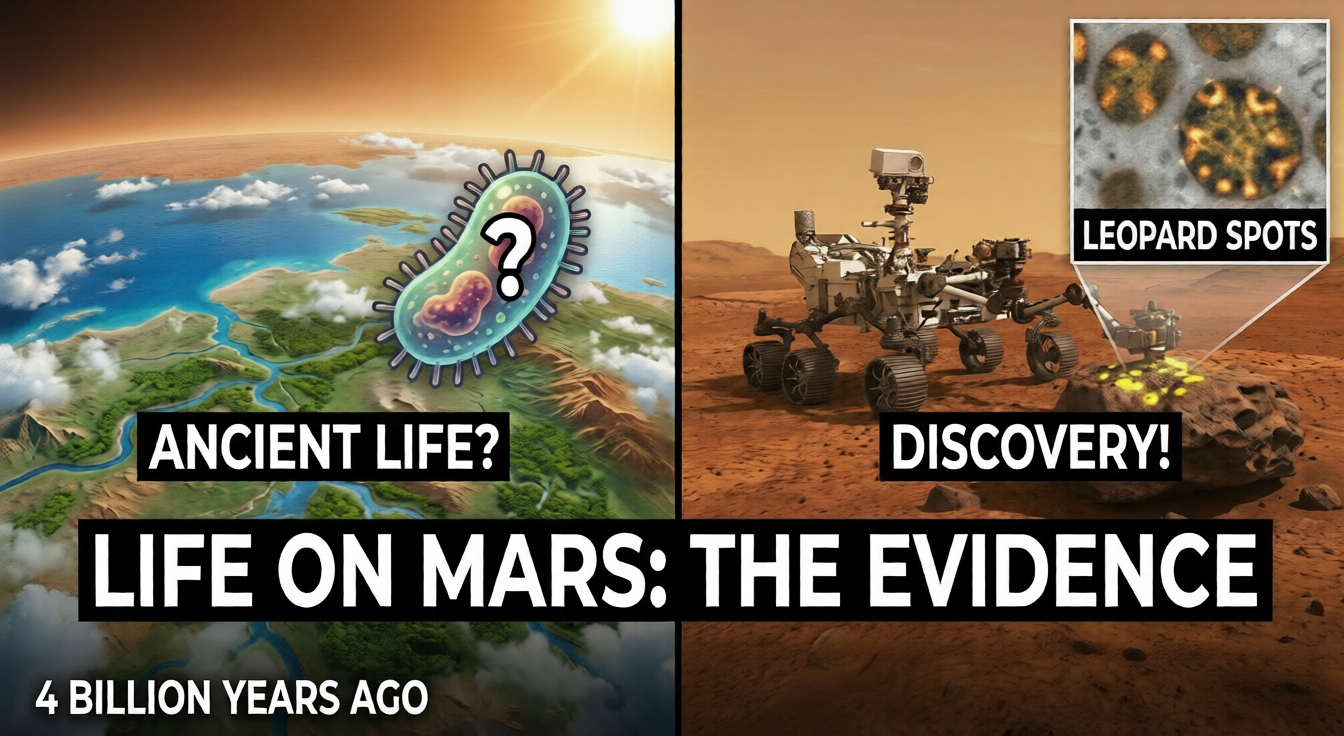
And it was here that Perseverance investigated sedimentary rocks like clay and silt, which are really good at preserving evidence of previous microbial life. Perseverance poked around some odd-looking mudstone rocks and found what could be the signatures of two iron-rich minerals: vivianite and greigite.
These colorful leopard spots could be fossilized signs that microbial life existed on Mars billions of years ago. Yeah, that's right. Microbes. That's what's at the core of the excitement around this core sample that Perseverance investigated.
When we look at these spots, we could be looking at evidence of ancient life on Mars. We haven't found life on Mars—we found possible remains of life on Mars. When scientists analyzed it in detail, they detected things like organic molecules, which is always a sign of possible life. Where we find this assemblage of minerals and organic molecules on Earth, it's inevitably associated with biology.
The Decline: End of the Hesperian Period
But we do know that back in this Hesperian period, Mars was still rocking active volcanoes, only not for long. As its magnetic field dissipated, the temperature dropped. Mars was losing its atmosphere and water became locked into ice.
Whenever asteroids smashed into Mars, the impacts superheated the underground water and created explosive flash floods—Martian tsunamis.
Could Life on Earth Have Martian Origins?
And here's something cool to think about. We know that billions of years ago, chunks of Mars often got blasted off the planet and landed on Earth. We have over 400 pieces of space rock with Martian origins. Which means if life was common on Mars back 3.5 billion years ago, could you yourself be from Mars?
It'd be wild, but anything is possible. There's a theory that life on Earth originated from microbes that immigrated to our planet, traveling on space dust, meteoroids, asteroids, comets, or even spacecraft. Now, Earth didn't see the first multicellular animals until about 800 million years ago, and those were just sponges, but they could be sponges from Mars. Who knows?
The Amazonian Period: Mars Becomes a Desert (2.9 Billion Years Ago)
By the end of the Hesperian period, things started going downhill for Mars. While its neighbor Earth was welcoming life, changing its atmosphere, and reshaping its surface, Mars was losing all the things that life could hold on to.
2.9 billion years ago, the Martian magnetosphere was gone. And without it, solar winds did what solar winds do and stripped much of the atmosphere. The air had become thinner and could no longer retain heat. Very quickly, Mars was becoming cooler and drier.
The Last Holdouts of Water
And that's bad news for the water on its surface. As the temperatures fell well below freezing, liquid water was disappearing, but it was still there. Yeah, at this point Mars still had some of its briny, salty water in isolated areas, but if you look around, you'll see that most of the oceans, rivers, and lakes were gone.
Volcanoes were on their way out, too. As Mars was cooling off, the volcanoes became less frequent, but you could still see Olympus Mons erupting occasionally. And these eruptions temporarily made Mars just a little warmer.
Every time Olympus Mons erupted, it didn't just spread lava, it spewed out greenhouse gases. For a short while, Mars may have warmed up, melting ice and unleashing sudden floods. These eruptions could be seen as the planet's last attempt to stay habitable.
The Fate of Martian Life
Now, what about all that potential life? Well, it's horrible news for those microbes, too. Back on Earth, microbes were thriving. Cyanobacteria started photosynthesis and pumped oxygen into the air. This began changing the composition of Earth's atmosphere.
But Mars wasn't going in that direction. It started to get a cold red desert vibe. Even if microbial life did exist 3.5 billion years ago on Mars, now it was dying in this increasingly hostile environment.
The only chance it had of surviving would be underground, protected from the harsh surface. If anything could survive on Mars, it'd have to be tough as hell, and it would probably have to be below the surface, maybe a meter, a few meters.
If any Martian microbes survived, they likely abandoned the surface and retreated underground into aquifers, caves, or close to geothermal hotspots, shielded from the radiation and freezing air above.
Living on Mars 1 Billion Years Ago: The Red Desert
Okay, finally we fast forward to 1 billion years ago. That's what you've been waiting for, right? Well, that's too bad because this is when Mars was inevitably becoming what it is today—a red lifeless rock.
This period of Martian history is called the Amazonian. It started 2.9 billion years ago and it's still going on today. Yeah, that's right. Mars has looked like this for a very long time. Dry, dusty, rusty red.
Whether it was 2 billion years ago or 1 billion or even today, if you lived on Mars, life would be the same. To be clearer, there wouldn't be any. At least not that we know of.
The Martian Environment 1 Billion Years Ago
So, here you are in the middle of the red desert. The atmosphere is thin, composed mostly of carbon dioxide. And the surface pressure is low, about 1% of Earth's. Surface water doesn't exist, or if it does, it doesn't last. It vaporizes.
Plus, it's freezing. By now, the average surface temperature has plummeted to about -60°C (-76°F). But occasionally, Olympus Mons erupts and warms up the surrounding area.
Olympus Mons: The Giant That Shaped Mars
If you don't know, Olympus Mons isn't your average volcano. At about 22 kilometers or 14 miles high, it's the largest volcano in the solar system. Yeah, three times taller than Mount Everest and about the size of the entire state of Arizona.
It started forming 3.5 billion years ago. For billions of years, it was growing, turning into a giant. It was able to do this without any interference because Mars doesn't have plate tectonics beneath its crust to move this mountain around.
And 1 billion years ago, it was still active. Not as active as in its best years, but it wasn't dormant. It spewed lava for hundreds of kilometers and reshaped and warmed the Martian surface around it. Back then, it could have been a Martian's last resort.
That underground heat could have created hydrothermal systems, which are a really good place for microbes to hide from the harsh surface conditions. Today, Olympus Mons is silent, just a giant feature on the Martian surface, one that's visible from space.
Mars Today: A World Forever Changed
From this point on, Mars didn't change much. Without an atmosphere or water, its surface is primarily changed by erosion, some late-stage volcanism, and lava flows. Strong winds also shape Mars, creating sand dunes and flattening the plains.
There could be underground water, but no oceans. And here and there, there's faint evidence of life like these leopard spots on rocks that shouldn't have spots.
The Challenge of Future Exploration
The search for life on Mars is going to get harder as time goes on. The spacecraft we send now, we decontaminate them as much as we can so that if we do find organic molecules or possible biosignatures, we're pretty sure that it's not contamination brought from Earth.
But once we start sending people up there—we're just bags of microbes and germs, right?—finding unambiguous signs of life is going to be harder because we're not going to be sure that it's not contaminants that we brought ourselves to Mars.
Getting the Samples Back to Earth
While Perseverance has collected a number of samples, we still have to get those samples back to Earth so we can study them properly. The current plan is a sample return mission in 2030, with the samples expected to come back to Earth in 2031.
Getting those rocks back is a complicated process. NASA is looking at sending a whole team of robots to get these samples and bring them back to Earth on a European Space Agency orbiter. But until that happens, we won't know for sure if there was ancient life on Mars.
Conclusion: Mars's Lost Potential
Mars represents one of the most compelling stories in our solar system—a world that could have been. From a potentially habitable planet with oceans, rivers, and possibly teeming microbial life, Mars transformed into the frozen desert we know today.
The recent discoveries by Perseverance rover give us tantalizing hints that life may have indeed taken hold on ancient Mars during its most habitable periods. If confirmed, these findings would revolutionize our understanding of life in the universe and remind us that habitability is a fragile, temporary gift that planets can lose.
Maybe one day you'll set foot on Mars, build a base, grow some potatoes, and try your best to survive on this ancient world that once held such promise for life. The red planet stands as both a cautionary tale and a source of hope—showing us what Earth could become, while also demonstrating that life finds a way to leave its mark across billions of years.