- Published on
What if Saturn replaced our Moon?
- Authors
- Name
- FeelTheShock
- @FeelTheShock
A huge gas giant suddenly appears in the sky. You look up and wonder. It's beautiful and terrifying. The second that Saturn replaces our moon in its orbit, Earth would just as suddenly stop being a planet. We would become a moon. Yeah, scientists would need to reclassify Earth. Well, that is if any scientist or any humans at all could survive this planetary switch because Earth's days would now be numbered. This is the first few minutes of Earth becoming a moon of this enormous gas giant.
The Sheer Size of Saturn
But before we get into what happens when Saturn captures our home planet with its unforgiving gravitational grip, well, let's talk about the sheer size of this massive giant.
Our moon, the moon, has a radius of 1740 km. That's just over 1,000 mi. And it's less than 1/3 of the width of Earth. It orbits Earth at a distance of about 384,000 km away. Now, to give you an idea of how far that is, well, you could fit about 30 more Earths between us and the moon.
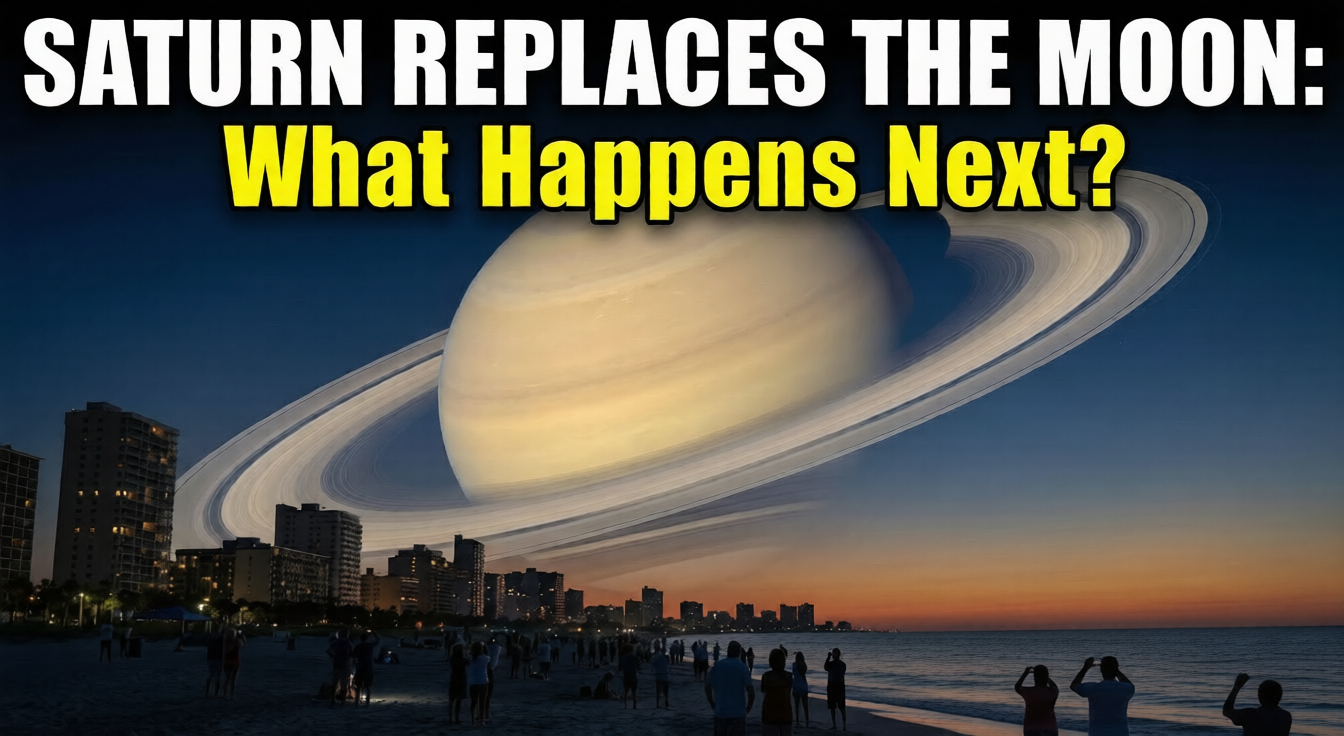
Now, if the moon were suddenly to be replaced by Saturn, it'd be pretty hard to miss. Saturn is 33 times wider than the moon. It would dominate the sky and the rings would make it even bigger, more spectacular, reaching the edges of the horizon. The scale is enormous. Saturn's rings stretch 282,000 km out from the planet. So, they'd be reaching out to us, their edges halfway between Earth and where the moon once was.
But Earth would be sitting around Saturn's equator. So, you wouldn't see these majestic rings the way we see them in outer space right now. Instead, from down here on Earth, they look just like a thin band because despite their incredible width, they're only about 10 m thick.
Mass and Gravitational Force
Now, just because Saturn is a gas giant and made mostly of hydrogen and helium, it doesn't mean it's light and fluffy. Saturn is the second most massive planet in the solar system. It's gigantic and heavy. This gas giant is 95 times more massive than Earth. And remember, Earth is 81 times more massive than the moon. So, according to my calculations, that would make Saturn 7700 times more massive than the moon.
And of course, you know what massive objects have, don't you? Enormous gravitational pull. Yeah. The moment Saturn appeared in the sky, it would start pulling our planet toward itself. Just like the moon pulls at Earth's oceans and causes tides. Well, so would Saturn, but on a scale that would be hard to imagine.
Catastrophic Tidal Forces
The gravitational pull would be thousands of times that of what we're used to. These extreme tidal forces would create enormous bulges in the oceans and seas. The tides would run out to sea like raging rivers and then rush back as waves hundreds of meters high. The ships would be left stranded on the ocean floor and then smashed by the returning water. Cities by the sea would be drowned, decimated.
And those gravitational forces wouldn't just be pulling on the Earth's surface. They'd be tugging at land, too. Earth's surface might seem sturdy to you, but it is actually quite delicate when it comes to planetary forces. Every fault line would be stressed past its breaking point. You'd be running from earthquakes that would spread everywhere. And from erupting volcanoes spewing toxic ash and gas up into the atmosphere, there'd be mega tsunamis and mega quakes. Cities would be shaken until they were nothing but rubble.
And if any emergency services were left after that, help would not be on the way. If you were stuck somewhere in the earthquake, well, that's it. Nobody's coming to save you.
Earth Becomes a Moon
All right, now let's get back to the destruction. We're not going to get rid of you that easily. Somehow you survived this initial chaos. All so that you could witness Earth transforming from our familiar stable planet to the unstable moon of an invading giant. In the first minutes of Saturn replacing the moon, all those eruptions and mega tsunamis would be tearing Earth to pieces. So enjoy the view if you can because things are going to get a whole lot crazier and deadlier.
Again, because of Saturn's enormous mass, Earth would immediately start to be pulled away from our usual trajectory. Like I said, Earth wouldn't be a planet anymore. It would be Saturn's moon and it would slowly change course and fall into an orbit around Saturn, but it wouldn't be like one of Saturn's usual moons like Titan. No, Earth would be in a death spiral getting pulled closer and closer to the gas giant.
Collision Course with Dione
Speaking of Saturn's moons, you see that gray rock growing in the sky? That's Dione. And yeah, it's bad news for you. Dione is no joke. It's Saturn's fourth largest moon, and it orbits the gas giant at about the same distance as the moon orbits Earth. And don't think you're catching a break in this episode. Dione is on a collision course with Earth.
Yeah, Dione is just about 1/3 the size of our moon, but that's still a pretty big rock that's about to hit our planet. Remember the Chicxulub asteroid that wiped out the most gigantic animals that ever roamed the planet? Yeah. Well, that dinosaur killer was about 10 km in diameter. Well, Dione is 100 times larger than that. Getting nailed by this moon would hurt a lot.
The Impact
At first, all you'd notice would be another new moon rising. Would look small and insignificant, but it would grow fast. And that means Dione is getting closer and closer until eventually it would reach Earth's oxygen-rich atmosphere and ignite into a massive fireball. Yeah. Our entire sky would be on fire.
And as it falls toward Earth, Dione would pick up speed. Its normal orbiting velocity of 10 km/s would ramp up, accelerated by Earth's gravitational pull. This dense rock moon, 1120 km across, hitting Earth's surface, would punch a hole deep into Earth's crust and instantly create a country-sized lava crater.
At impact, the energy that gets released would send out a fiery shock wave, sweeping around Earth at thousands of kilometers per hour, incinerating everything in its path. Earthquakes would spread out around the world from the impact crater, leveling cities, forests, even mountain ranges. The blowback from the impact would eject a blob of molten core up into the sky, falling back to Earth as searing hot lava rain.
If the impact was at just the right angle and velocity, well, the blob of molten rock would be rocketed into orbit to become another moon. But it would be a moon to a very different Earth than we know today. This new Earth would be a fiery, uninhabitable ball covered with red hot magma oceans. Every single living thing would be killed. The surface of Earth would be sterilized. Some extremely hearty bacteria living in warm volcanic plumes deep at the bottom of the ocean might be the only survivors and even then only for a short time. Otherwise, all life would be gone.
A Glimmer of Hope?
But hold on. How about some good news? Well, I don't know what your definition of good news is, but at least Earth would be safe from most of Saturn's other moons, especially the largest one, Titan. Titan orbits Saturn at a distance of 1.2 million km, which is three times the distance that our moon is from Earth. So, if Saturn became our new moon, well, Titan would still be pretty far out in space, which is fortunate because Titan is five times as big as Dione. It's bigger than Earth's moon. A collision with Titan would be a planet smashing game over for us.
But what if Earth managed to scrape past Dione and continue our journey towards Saturn?
The Lunar Obstacle Course
Well, it wouldn't exactly be smooth sailing from here on in. We'd be heading for a disaster unlike anything Earth has ever experienced. In the unlikely event that you were still alive, well, you'd witness Saturn getting bigger and bigger in the sky, blocking out everything else. Quite a sight. But just because we snuck by one moon doesn't mean we're out of immediate danger.
Saturn has 274 confirmed moons in its orbit, more than any other planet. Some, like Titan, are as big as planets themselves. But others are just 20 km across, like Pan. Lucky for Earth, if Saturn replaced our moon, there'd be just 11 of these moons left in the distance between the gas giant and us. But yeah, Earth would be drifting through an obstacle course. More good news though, most of these moons are small and impact would only be slightly catastrophic.
Encounters with Tethys and Mimas
But as Earth passes the 300,000 km away from Saturn mark, we'd be in danger of smashing into Tethys, its fifth largest moon. A collision with Tethys would be similar to a collision with Dione and just as destructive. Even if we snuck by with a close scrape with Tethys, Earth would be rocked by new, even more destructive tidal forces. A close flyby would cause whatever was left of our oceans to slosh around. Waves hundreds of meters high would smash ocean shores.
At 180,000 km away, we'd be getting close to another moon of Saturn, Mimas. A small moon a mere 392 km wide. An impact or scrape with Mimas would further agitate our atmosphere and stress the surface. It might even tear a strip off the atmosphere as it glided by it.
The Lone Survivors
It's hard to imagine anyone still alive on Earth's surface at this point. The sheer mechanical destruction from earthquakes as the crust is stressed and being pulled by increasing gravitational forces of Saturn would have leveled every structure, thrown up new mountain ranges in a matter of minutes, and turned our seas into boiling water. Something orbiting in space might have a slim chance of making it through all this in one piece, like astronauts trapped on the International Space Station, pulled along for the ride.
If they were lucky enough to avoid being crushed by a passing moon or slingshot into space by gravitational forces, they'd be the only humans left to witness this unprecedented planetary event.
Plowing Through Saturn's Rings
Imagine peering out the window of your space station and watching as Saturn's rings get closer and closer. And then suddenly you're in them. From afar, the rings of Saturn look ethereal and airy. But the reality is that Earth would be plowing through trillions of chunks of ice and rock. Some the size of dust, others huge boulders.
As shards from the rings begin to hit Earth's atmosphere, they'd ignite and turn into flaming meteors. But down on Earth's surface, there'd be no one left to watch the most spectacular meteor shower ever. From a distance, it would look like Earth was a giant eraser rubbing out an Earth-sized section of the rings. Earth would clear out huge swaths of ring debris and fling others out of their orbit, leaving a trail of flowing dust, rock, and ice.
By this point, even a surviving space station would be pulverized, being hit by thousands of ice chunks as it passed through the rings. Nothing humans have ever built for space exploration could survive that.
The Final Descent
As Earth gets to the 120,000 km range, well, then its trajectory would start to resemble a true orbit. As Saturn's immense gravitational force continues to pull on Earth, it would swing around the massive gas ball. And as it did, it would sink into darkness for hours at a time, thanks to Saturn's enormous shadow. But this cozy orbit wouldn't last very long.
All right, about 3 days into this nightmare, Earth would be at a distance of 71,000 km from Saturn, and it would be approaching a force even greater than crashing through Saturn's rings or colliding with one of its moons. Earth would be reaching its Roche limit with Saturn.
The Roche Limit
The Roche limit is the zone where the gravitational and tidal effects of a large object are powerful enough to overcome the gravitational forces that hold a smaller object together. In this case, Saturn's gravity versus Earth's will hardly be a fair fight. Saturn is just so much more massive than Earth. Like we said at the beginning, 95 times more massive.
The gravitational forces holding Earth together in its spherical shape won't be able to resist the force of Saturn's gravity pulling on the side of Earth that's facing Saturn. At this point, so close to Saturn, Earth would literally be pulled apart. Within hours of drifting past its Roche limit, Earth would be ripped into billions of pieces of floating space debris.
Some of those might clump together, forming new, smaller objects, but most of them would spread out and turn into a thin band of rocky shards orbiting Saturn. Sound familiar? Yeah. Earth would end up yet another majestic ring of Saturn.
That's actually how we theorize the rings forming in the first place, as remnants of small moons or asteroids pulled apart by Saturn as they crossed their own Roche limit. Maybe someday in the distant future, intelligent life from another solar system will arrive in ours. And maybe they'll wonder at the mystery of Saturn's newest ring.
What's Next?
Now, what else can we replace our moon with? Well, how about the other moons in the solar system? Well, that's a story for another shock.