
- Published on
What if the largest flying animal ever lived today?
- Authors

- Name
- FeelTheShock
- @FeelTheShock
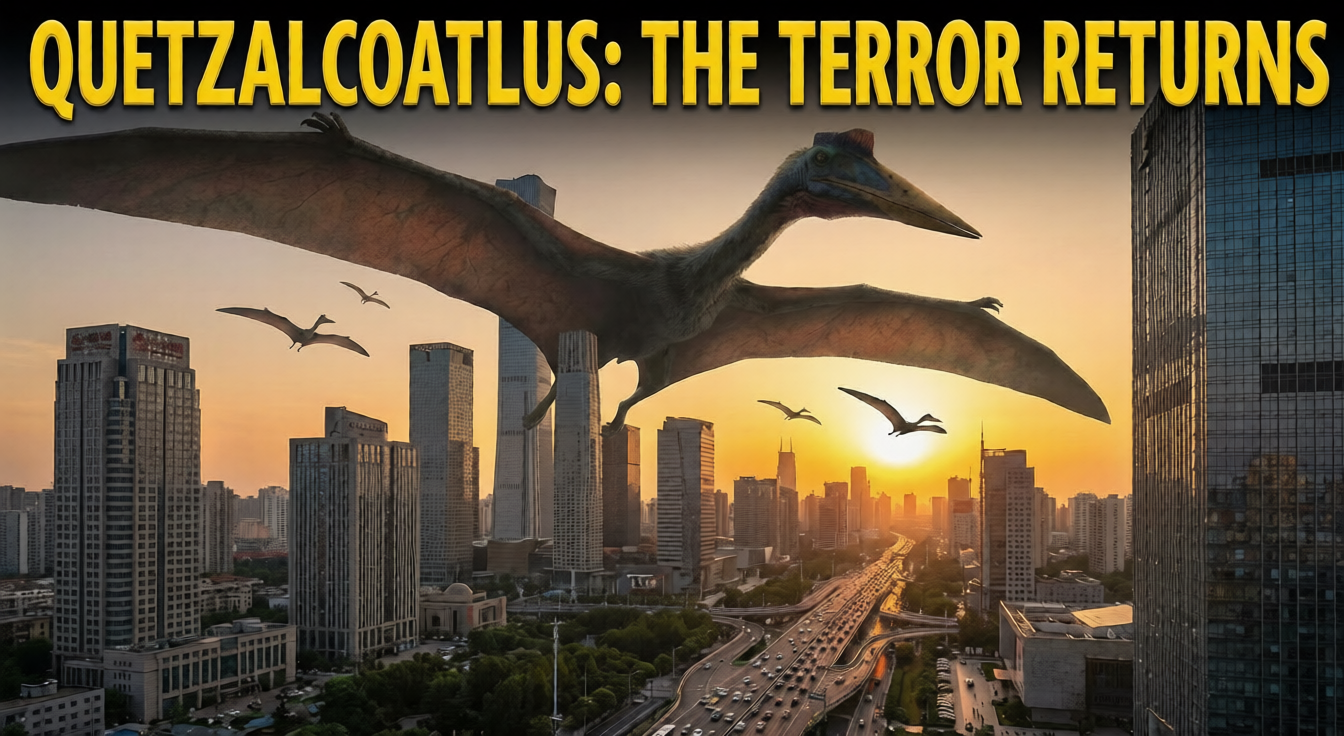
A terrifying shadow ripples over the city as a gigantic prehistoric beast soars over the towers, moving faster than the cars on the freeway, hunting. And it's not alone. It hunts in a pack. This was and is Quetzalcoatlus because today we're bringing this horrifying creature back from extinction. How exactly did Colombian drug lord Pablo Escobar get mixed up in all this? Well, hold on. We'll get to that in a minute.
What exactly is Quetzalcoatlus?
Now, what exactly is Quetzalcoatlus? Because I know what you're thinking. That thing looks a lot like one of your favorite dinosaurs, the pterodactyl. But Quetzalcoatlus isn't a dinosaur at all or a pterodactyl. This enormous flying creature is what we now refer to as a pterosaur. And that means it's a reptile, a big one.
Quetzalcoatlus lived around 72 million to 66 million years ago during the late Cretaceous period when it blocked out the sun with its 12 m (40ft) wingspan. When it landed on the ground, it stood at a towering 5 m or 16 ft and its enormous neck was what took up most of that height. That makes it 3 m taller than poor Digi Peter, our boots on the prehistoric ground.
That stature put Quetzalcoatlus at nearly the same height as a giraffe, except that instead of a big lovable freckled giraffe head, Quetzalcoatlus had a long pointed beak between two and 2.5 m in length. Basically, this thing was as big as a giraffe with a giant spear sticking out of its head. And it could leap into the air and fly. Pure nightmare fuel. A nightmare that ruled the skies of the late Cretaceous.
The Cretaceous World
A warm, temperate period with shallow seas, rainforests, and hardly any snow. It was a pretty sweet time period temperature-wise. Lots of oxygen in the atmosphere and plenty to eat. Scientists have debated Quetzalcoatlus' exact habitat and diet since it was first discovered. The working theory today is that Quetzalcoatlus was a terrestrial stalker, which means that even though it was a flying creature, it hunted on the ground or in shallow waters.
Think of it like a giant blue heron or stork, but a giant stork that weighs 250 kilos and stalked around on its wings like an enormous vampire bat. Not great news for Digi Peter. If it could track Digi Peter down here, could it devour him? Not yet, it seems.
The Great Extinction
Fortunately for us and the rest of the mammals out there, Quetzalcoatlus was the overlord of the skies in the last chapter of dinosaur and flying reptile history. Like T-Rex and Triceratops, it died out in the end Cretaceous mass extinction 66 million years ago when the asteroid known as Chicxulub struck Earth.
This asteroid's impact laid waste to North and South America, incinerating forests, setting off tsunamis, blasting hundreds of billions of tons of dust and gas into the atmosphere. The far side of the planet may have escaped the worst of the inferno and shock wave, but nothing on Earth was safe from the long, dark winter that followed. Gas and soot from the explosion coated the sky. Temperatures dropped. Ecosystems cratered.
The Survival Scenario
But what if 66 million years ago on the farthest side of the planet on a remote island in the Indian Ocean, a small population of Quetzalcoatlus managed to survive and remain hidden from human eyes for millions of years? Yeah, after the asteroid hit, the world belonged to the species that adapted fastest.
Look, we know that huge apex predators are the first to go when the food chain collapses. But what if there were a few hearty, clever Quetzalcoatlus in the right spot at the wrong time? The survivors of giant flying reptiles who refused to quit, who ate everything and anything and took to the air until they found just the right place to survive.
Christmas Island: The Perfect Refuge
Now, somewhat coincidentally, there is a small remote island, Christmas Island, hundreds of kilometers off the coast of Indonesia and Australia, and it kind of fits the bill. Geographically speaking, Christmas Island wasn't around 66 million years ago. But for our thought experiment, what if it formed a little earlier?
It's covered in tropical rainforest, and it's temperate. It's surrounded by coral reefs and it's full of crabs. Delicious, nutritious crabs. So, what if a tiny family of these huge pterosaurs managed to hang on by the skin of their non-existent teeth on Christmas Island, or an island just like it, and survived the worst of the period after the extinction event, and then went on to quietly rebuild their population over millions of years, out of sight from humanity?
Adapting to the Modern World
Could they actually survive in this modern day? Well, if they adapted to the oxygen in the atmosphere over millions of years and evolved to handle the shifting temperature, of course they could. Scientists think that Quetzalcoatlus didn't soar thousands of kilometers, but they were more of a short range, hundreds of kilometers flyer. It makes sense that they got stuck close to home and didn't make it to the mainland.
Now, Christmas Island wasn't spotted until the 1600s and was most likely uninhabited until the late 1800s. So, what happens when humans make first contact after 66 million years?
First Contact with Humanity
Well, the minute we first see them, we probably panic and then run. Digi Peter does. He's no fool. And then we bravely sail away and put a big X on the map to say stay away from this godforsaken horrible island. But eventually some enterprising explorer would try to do what many enterprising explorers do whenever they discover a peacock or a tiger or a Tasmanian devil: capture a few wild specimens and start a zoo or a traveling circus.
People flock to see it. So for decades, the majority of humans see Quetzalcoatlus like they might see a penguin or a Komodo dragon or a giraffe in zoos or on extremely dangerous safaris.
Keeping Giants in Captivity
But how could we keep this giant reptile in captivity? Scientists theorized that Quetzalcoatlus would jump two to three meters into the air and flap their enormous wings to gain altitude before soaring. By keeping them in cages without any headroom or on short chains or leashes, it might be possible to contain them, but humans aren't always ready for the raw power of ancient reptiles.
And over the years, there are incidents recorded of escaped individual Quetzalcoatlus. First, in neighboring Australia, there's the one that made off into the wild and lived in the rainforests of New Guinea. But humans never allow a breeding pair to establish on the mainland until Pablo Escobar.
Pablo Escobar's Private Menagerie
Yeah, Pablo Escobar. He sees a photo of Quetzalcoatlus in the 1980s and decides he must have it for his zoo. But not just one, he wants four. Yeah, that's right. Pablo Escobar, the notorious Colombian drug lord, the feared billionaire cocaine kingpin who also had a sizable personal zoo. Giraffes, elephants, kangaroos, and four hippos.
Now, why would anyone want hippos? Hippos are some of the most violent, dangerous, and aggressive animals on the planet. They kill hundreds of people every year, more than any other dangerous big predator in Africa. But we're not talking about hippos. We're talking about a gigantic prehistoric reptile that could eat children whole.
Who would want to keep a Quetzalcoatlus? Well, someone who already kept big dangerous animals like hippos in their own personal zoo and had their own personal dinosaur theme park, namely Pablo Escobar. And he wanted four of them just like the hippos. And because he was one of the most powerful dangerous men on the planet, he got four Quetzalcoatlus.
The Great Escape
Now, in real life, when Colombian paramilitary forces stormed Escobar's compound in the early '90s and he wound up dead, his hippos escaped into the wilds of Colombia and established a breeding population. Today, there are hundreds of hippos causing havoc in Colombian rivers. It sounds absolutely crazy, but it's true. They're a complete menace.
Now, at the same time, what if his four Quetzalcoatlus also escaped into the nearby Colombian rainforest into the Amazon and started breeding? Suddenly, Quetzalcoatlus escapes their captivity and their core population expands throughout South America, then quickly spreads north through Mexico, Cuba, all the way to California, further north than you think.
Invasion of the Americas
Quetzalcoatlus are warm-blooded and insulated with hair-like fibers, so they can regulate their body temperatures even in today's cooler climates. So, what happens when Quetzalcoatlus and humans collide? Well, murder hornets, Burmese pythons, and feral boars have got nothing on these things. It turns into absolute mayhem.
Agricultural Catastrophe
It starts, as it often does, with dangerous wild animals whose habitat runs adjacent to humans, with conflict on farms and ranches. Local farmers in South America leave their flocks of lambs or goats unattended for a few minutes, followed by hellacious screaming and then silence. They returned to find their flocks decimated. Most of the youngsters gone and the adult sheep and goats terrified. The sheep dog missing and silhouette of the biggest heron they've ever seen soaring across the farm.
After millions of years of surviving on crabs and fish, penned up farm animals present the easiest buffet a skybound super predator could ever imagine. The giant reptiles devour entire herds. Quetzalcoatlus eat whatever wild animal of a certain size they encounter. Animals in neighboring forests suffer the most like young deer, capybara, and crocs. Basically, anything big enough to attract the giant reptile's attention and light enough to get snapped up into their gullets.
How do you fight a flying predatory giraffe? With all that easy food, the infinite protein, the Quetzalcoatlus grow stronger, reproduce faster than they ever had before, and their territory spreads.
Urban Encounters
Undeterred by the weird mammals, the Quetzalcoatlus take notice of cities and descend on the easy pickings there. A dog park to a 17 ft flying lizard, it's more like a hot dog park. Adult humans are relatively safe. The Quetzalcoatlus seems to ignore them. One recent study estimated that the majority of Quetzalcoatlus prey was in the 9 to 13 kilo range, 20 to 30 lb. That covers most dogs, cats, chickens, a lot of baby farm animals, and yeah, small humans.
We quickly realized that we may have to rethink almost every aspect of open gathering areas without a roof, like parks and farms. But let's face it, we're not great at changing our infrastructure in a hurry.
The Ecological Impact
Also, a lot of pesky urban wildlife would disappear. Raccoons, stray cats, or dogs, or iguanas or rats. And in their place there's a mess. If you've ever been, how do I put this delicately? Defecated on by a pigeon, you know it'll ruin your day. Wait till Quetzalcoatlus drops a load while flying overhead.
And while you might think, "Hey, we can just drive them off." Why would these creatures back down from anything that's not a Tyrannosaurus Rex? They're total apex predators with nothing to fear from any animal on Earth. Except maybe a land tank like an elephant. Any human trying to shield their pet from being a prehistoric snack without wielding a flamethrower would likely get stomped on.
The Human Response
And that's where the tide turns. One day, Quetzalcoatlus goes too far. At some point, Quetzalcoatlus made the unwitting mistake of eating an entire classroom of kindergarteners or troop of girl guides. And humans go mama bear. We reach for an automatic assault rifle or attack helicopters and we go hunting.
Now, while there are calls to domesticate Quetzalcoatlus, it's impossible. They're too big and dangerous. And there are calls to ethically sterilize the flocks of Quetzalcoatlus in much the same way that the Colombian government is attempting to sterilize those wild hippos. But it's complicated. Quetzalcoatlus has threatened human children.
The Great War
So, humans decide to protect their own to show the apex predator of the Cretaceous period that this is a new era and there's a new apex predator in town. Homo freaking sapiens. And then the widespread culls begin. Humans and Quetzalcoatlus engage in full-on interspecies warfare and it is madness.
But the end result? Humans band together for the first time in history to drive the reptile threat from the skies, hunting them down relentlessly until every playground, farm, and school is safe. Until the giants can survive only on their own home territory of Christmas Island, hunting crabs in the Indian Ocean under close surveillance.
Back Where They Started
This would leave Quetzalcoatlus exactly where they started, 66 million years ago, surviving and thriving in an odd window back to a time of the dinosaurs and giant flying reptiles.
Okay, now that was bringing a giant reptile back from extinction, a thought experiment only. But why not try a gigantic snake? Well, that's a story for another shock.