
- Published on
What If We Swapped Our Moon With Other Planets?
- Authors

- Name
- FeelTheShock
- @FeelTheShock
We're going to swap our Moon for some of the most dangerous alien planets. We'll start easy with a potentially habitable exoplanet, and then we'll see what life on Earth would be like if a super hot planet larger than Jupiter was wreaking havoc in our orbit.
Proxima Centauri b: The Closest Habitable Exoplanet
The first on our list is Proxima Centauri b. This planet is not just potentially habitable, it's the closest promising exoplanet to us, only 4.2 light-years away. Well, 4.2 light-years away is still far. To put it in perspective, Voyager 1 travels at an average speed of 17 kilometers per second. And at that speed, it would take Voyager 75,000 years to get to Proxima Centauri b.
This world has about the same mass and is about the same size as Earth, maybe just slightly larger. So if Proxima Centauri b suddenly appeared in our sky, it would look magnificent and big, four times larger than the Moon and about 85 times more destructive.
The Binary Planet System
You see, Earth and the Moon are in this perfect tidally locked system. The Moon orbits Earth, causes tides, and reflects sunlight to light up our night sky. Proxima Centauri b wouldn't be tame like that. No, it's not some interstellar moon. It's an entire planet. And it's 85 times more massive than our Moon.
That means it wouldn't just orbit around Earth. It would tug at it with all its mass until Earth and Proxima Centauri b started to orbit each other, turning into a binary planet system. And that system would wobble around the sun.
Climate Changes on Both Worlds
For Proxima Centauri b, it would be great news. Back in its own planetary neighborhood, it orbits a small red dwarf star and only gets about 65% of the sunlight Earth does. Moving Proxima Centauri b into a sunnier part of the universe would warm it up nicely. From where it sits now, this exoplanet might not have an atmosphere, and that means it can be pretty chilly with an average temperature of -30°C (-22°F).
If it does have an atmosphere, it could already be Earth-like and ready for you to settle on. We just don't know for sure what the atmospheric situation is until we actually get there. In any case, if Proxima Centauri b was in the habitable zone of our solar system, it would turn into a pretty balmy place. With a little terraforming effort, well, it might as well become Earth's twin.
Devastating Effects on Earth
But to do that, you'd first have to survive all the havoc that's going to happen on Earth. Our new planet-moon binary partner would cause enormous tides. I'm talking 80 times stronger than what our current Moon causes. Coastlines would be hit the hardest. At high tide, cities like New York, Mumbai, and Cartagena would be submerged.
Deadly tides wouldn't be the only danger. The ground inland would bulge under the gravitational effects of Proxima Centauri b. It would go up and down 10 cm (4 inches) twice a day. And in this binary dance of two planets, Earth's rotation wouldn't be as fast as it is now. Earth would slow down by a lot. One day here could now last 580 hours.
This long day-night cycle would be bad news for our global temperatures. The climate on Earth would change and humanity would have to adapt to these changes fast. So there you have it: unpredictable climate, extremely long days, mega tides. But hey, what a view.
Kepler-22b: The Famous Ocean World
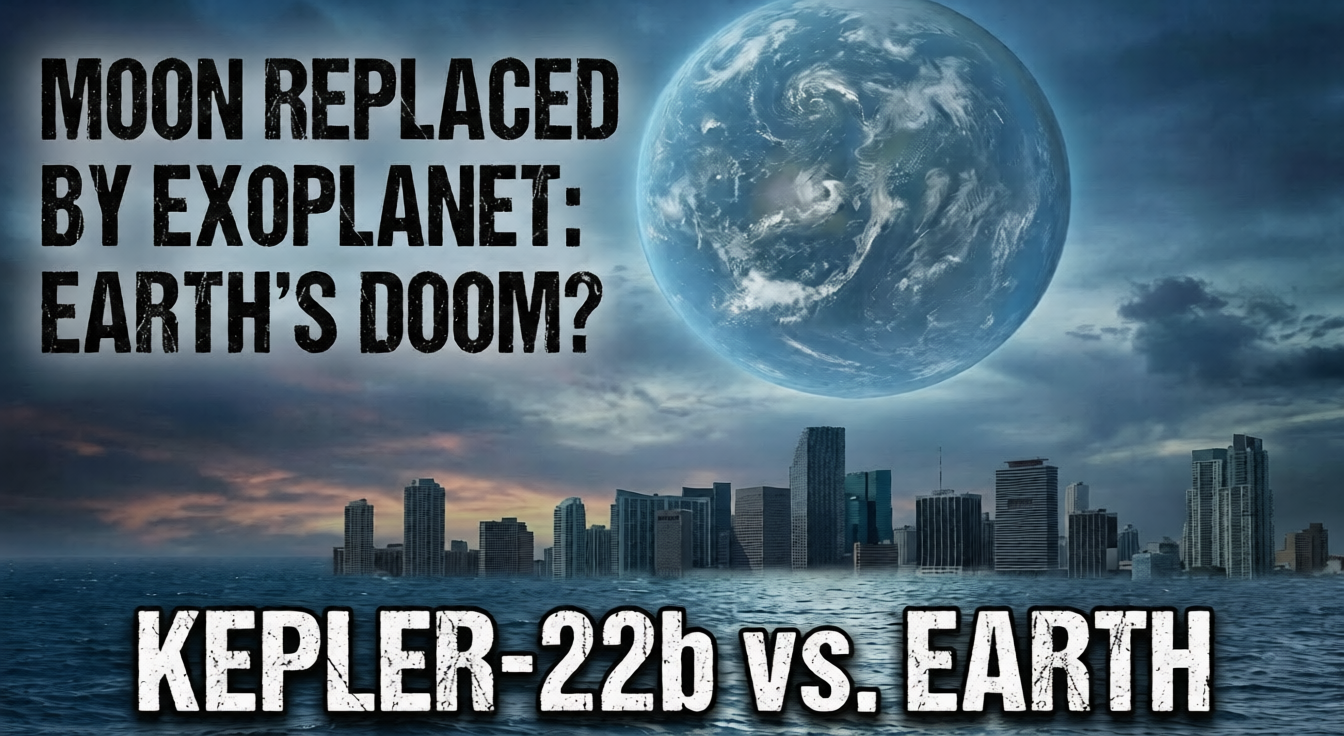
Kepler-22b has to be the most well-known exoplanet out there. Like I said, Kepler-22b is far from us, 635 light-years away. Still, it was the first world we discovered orbiting in a habitable zone of its sun-like star. The problem with Kepler-22b? It's big. 2.4 times larger than Earth, and scientists estimate it carries the mass of nine Earths.
A Beautiful but Deadly View
So, yeah, things are going to get destructive. If this rock replaced the Moon, it would take up a significant chunk of our sky. It would look really pretty. We at What If like to imagine Kepler-22b as a rocky world that you can step on and explore. But scientists think it might be an ocean world. And if it is, it would reflect quite a lot of sunlight and shine brightly in the sky.
It's too bad you couldn't enjoy this view for very long, because soon you'll be battling the effects of our new moon-planet that's hundreds of times heavier than our regular Moon.
Binary System Chaos
Similar to Proxima Centauri b, Kepler-22b would refuse to be just the Moon. It would force the Earth into a binary planet system where both planets would orbit each other. But that's not the problem. The problem is the tides. The massive, gigantic, higher than anything you've ever seen tides.
Picture tides from Proxima Centauri b and multiply them by a lot. Add a sprinkle of Earth-shattering earthquakes and volcanoes and you get the picture. Earth is doomed. It's time to move to Kepler-22b. It's so close. But don't rush into landing there.
Unstable Climate
Kepler-22b might be promising, but we don't know for sure. Astronomers noticed that back in its regular orbit, Kepler-22b has a strongly inclined and elliptical orbit as it moves around its star, sometimes getting closer, sometimes further from it. It's got wild temperature variations and an unstable climate. And Kepler-22b doesn't have its own moon to stabilize its climate.
So moving to our solar system right in the habitable zone could be the best thing to ever happen to Kepler-22b. But it would take time for the planet to adjust to a proper orbit, the right amount of sunlight, and maybe even get some climate stability from the gravitational effects of Earth.
Planetary Collision Course
Only you wouldn't have the time because if never-ending natural disasters didn't wipe humanity out, the massive planetary collision would. As the two planets danced in a binary system, they could become unstable. The tidal effects of both worlds could draw Earth and Kepler-22b on an extreme collision course.
Now, Earth has had smaller planets like Theia smash into us in the past, but Kepler-22b is huge. Kepler-22b would grow bigger and bigger in the sky until eventually the worlds would collide and Earth would not survive this binary dance.
55 Cancri e: The Hell Planet
Okay, that was bad. Now, let's try replacing our Moon with a hell ball of a planet: 55 Cancri e. I'm not just saying hell to be dramatic. 55 Cancri e is terrifying. Back in its own star system, this exoplanet orbits way too close to its star, 55 Cancri A, and it orbits fast. One year here lasts only 18 Earth hours.
Floor Made of Lava
Now because it's so close to the star, on Cancri the floor is lava. Yeah. Everywhere. Scientists think the temperature on this hellish rock can reach 2,700°C (almost 5,000°F). Now that's hot. It's so hot that if this planet does have any atmosphere, it's likely just vaporized rock.
Having a hot mess of a planet replace our Moon isn't something you'd ever want to see, but here you go. It would look huge in the sky, and at first it would be glowing. 55 Cancri e is about double the size of Earth, but it has 8 times Earth's mass. So, this rock is dense.
Diamond Interior
The really cool thing about it is that its interior might be diamonds. The bad news is you're never getting off Earth to travel to 55 Cancri e to mine all those diamonds. And you likely wouldn't care about diamonds at that point because having this big blazing rock in our orbit would make your life pretty difficult.
Extreme Destruction
The terrifying tidal stress from our new neighbor would cause not only extreme tides hundreds of times stronger than what we have now, but also frequent earthquakes and volcanic eruptions. Humanity's extinction might be caused by Earth shaking from the inside.
55 Cancri e would quickly make Earth its moon. Yeah, Earth is smaller and has quite a lot less gravitational pull in this planetary relationship. So instead of Cancri orbiting us, we'd be orbiting Cancri. Eventually, Earth would also become tidally locked to 55 Cancri e, always showing one of our torn sides, just like our Moon does now.
For Cancri, things would be different, too. Within months, it would cool off and its lava surface would solidify. Soon, it would become a gray-brown rock in the sky. Only you wouldn't be around to see it. Unlike Proxima Centauri b, 55 Cancri e would have zero chance of becoming habitable even in the habitable zone of our sun.
WASP-12b: The Egg-Shaped Gas Giant
But things can get a lot worse than Cancri e. Enter WASP-12b. This planet looks funny, like an egg. A hot, scorching, gigantic space egg. WASP-12b isn't just any planet. It's a hot Jupiter-like gas giant, which means two things. One, you can't land there because this massive gas ball doesn't have a surface. And two, you don't want to land there because it's scorching hot.
Being Eaten by Its Star
This exoplanet is one of the most extreme worlds we've ever found. It's seething at 2,300°C (4,100°F), and it's distorted into an egg shape because it's so close to its star that it's being eaten by it.
If this blazing giant suddenly appeared in the orbit around us, it would look extremely large. At 80 times larger than the Moon, it would cover the entire sky and it would be close, too. WASP-12b is almost double the size of Jupiter. Its radius is 1/3 of the distance from Earth to the Moon, but it wouldn't look so bright. This planet would look dull because, well, it just wouldn't reflect all the sunlight that the Moon does.
Earth Becomes a Moon
Well, this view wouldn't last long because for Earth, things are about to get bad. WASP-12b has a mass of tens of thousands of moons. It would tear Earth apart with gigantic tsunamis. But you'd have bigger problems to worry about. Immediately, Earth would become a moon of WASP-12b.
Earth's crust would tear under such a dramatic gravitational pull from its master planet. Mega-quakes would rip the surface and cause unimaginable damage. Humanity would not survive this switch. And if we did, we'd struggle to get sunlight from our sun, as WASP-12b would be creating constant solar eclipses.
So yeah, WASP-12b might be the absolute worst candidate to replace our Moon. Unless we try placing Beta Pictoris b in the orbit around Earth.
Beta Pictoris b: The Super Jupiter
WASP-12b was gigantic. Beta Pictoris b is gargantuan. Remember super-Earths? Well, this world is a super Jupiter. It's 1.7 times bigger, almost 12 times more massive, and 100% much worse than Jupiter. It's a newborn gas giant that's still glowing from the heat of its own formation.
Filling the Entire Sky
It's so big that if it did suddenly replace our Moon, it would fill the entire sky. This giant would be stretching 60 moons wide. It would block out constellations, swallowing the Milky Way behind it. You wouldn't get nights anymore. You'd get a kind of dim, eerie twilight.
But this view—wouldn't it be something? But it wouldn't be something you could enjoy for long because Beta Pictoris b is about 4,000 times the mass of our Moon. Drop that into lunar orbit and Earth would surrender immediately. Our planet would stop being a planet and would start becoming the moon of Beta Pictoris b.
Ultimate Destruction
Cue the destruction. The tides would stop being waves and start being walls hundreds of meters tall. They'd crash into continents, wiping coastlines off the map every single day. The ground wouldn't stay still, either. Earth's crust would flex under the gravitational pull of this monster, rising and falling kilometers at a time.
Beta Pictoris b would rip open fault lines and trigger planet-wide volcanic eruptions. Earth would basically become Io, Jupiter's tortured volcanic moon, only worse. Beta Pictoris b would block the sun so often that temperatures would swing wildly. Ash would fill the skies. The entire planet would become a geological blender—shaking, boiling, and burning.
So yeah, if you ever look up and see Beta Pictoris b filling the sky, glowing like a dying star, well, you know that's the end.
Bad for Both Worlds
Now that is the absolute worst of the worst. And it wouldn't even be great for Beta Pictoris b. Back in its system, Beta Pictoris b orbits far from its young star. Here at Earth's distance from the sun, it would suddenly get blasted with way more sunlight than it's ever seen. Its atmosphere would heat up and violent storms the size of Earth would rupture through its cloud tops.
Yeah, being this close to the sun isn't stable for a giant like Beta Pictoris b. Our star's gravity would start pulling on its outer atmosphere. Not enough to strip the entire planet, but enough to shear off the top layers of gas. Eventually, Beta Pictoris b might even start migrating toward the sun.
The gravitational war between the Earth, Sun, and this monstrosity of a planet would destabilize everything. Beta Pictoris b could tag in Mercury and Venus on its way to the sun. These rocks would join Earth in the club of Beta Pictoris b's moons. Things would be bad for everything inside this new solar system.
Conclusion: Why Our Moon is Perfect
Can we bring back Kepler-22b instead? Oh, it's too late. You know, I think there are better things to do to our Moon. Like, let's give it its own moon. But that's a story for another shock.
Our Moon might seem ordinary, but it's perfectly sized and positioned to give us stable tides, help stabilize our climate, and provide just the right amount of gravitational influence. These thought experiments show us just how catastrophic it would be to mess with that delicate balance—and why we should appreciate our cosmic companion just as it is.