
- Published on
What If You Fell Into the Biggest Void in the Universe?
- Authors

- Name
- FeelTheShock
- @FeelTheShock
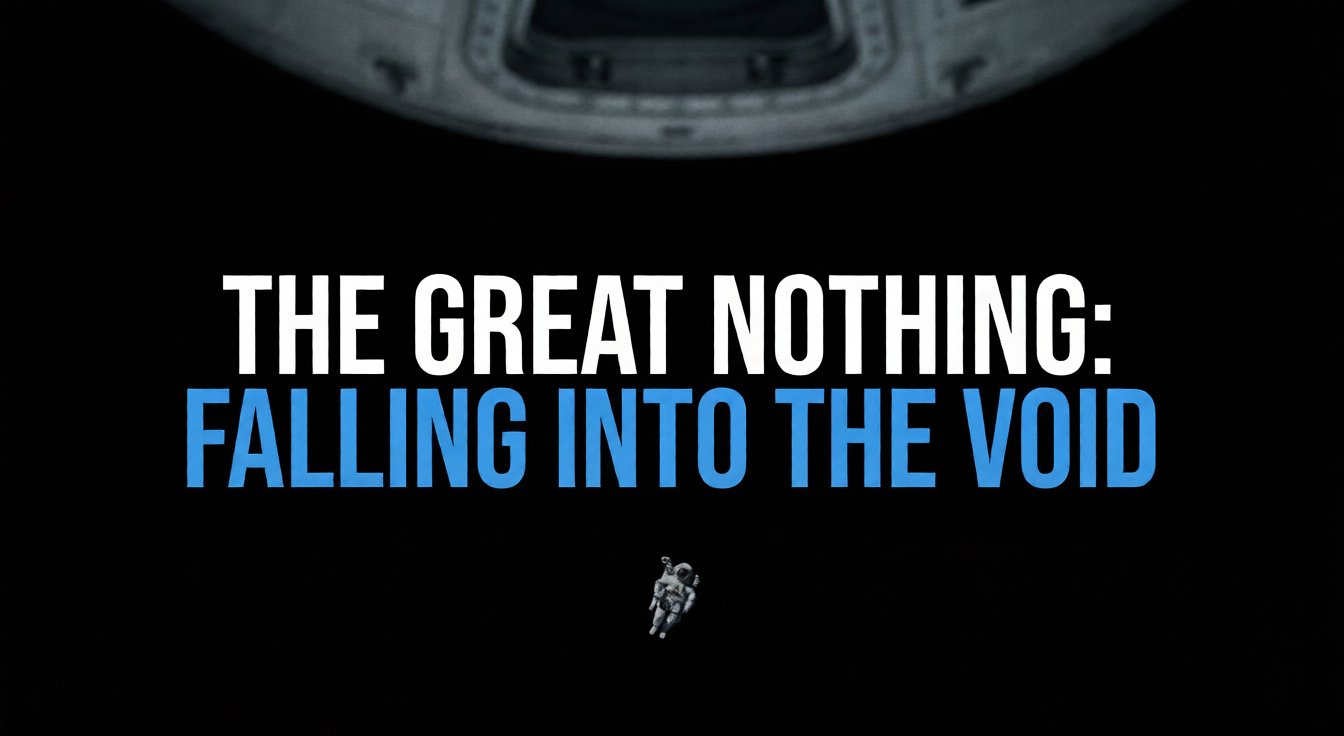
You are an astronaut tumbling through the greatest stretch of cold darkness in the known universe. It's a place where nothing exists. A place without stars, planets, or galaxies. A place where you wouldn't meet a soul for hundreds of millions of light-years. Yeah. This place is called the Boötes Void, or as I like to call it, the Great Nothing.
And unless you find your way back to your ship, you'll be drifting through the perplexing dark of this mysterious nothing for billions of years. That is, your frozen, desiccated body would drift through this expanse for billions of years because there's no one out here to retrieve you.
Where Is the Boötes Void?
What's fascinating about this space is that you've been staring at it this whole time. The Boötes Void sits in the Boötes constellation in the northern sky. You can barely see it from Earth, but it's there. And you don't want to end up there, but that's exactly where you're going.
What would it be like to fall into this incomprehensible ocean of darkness? Well, first, it would take you a near incomprehensible ocean of time to reach it.
The Journey: 700 Million Light-Years Away
The Boötes Void is 700 million light-years away from Earth. And I don't need to tell you that's far. To put it in perspective, the Andromeda galaxy is our closest major galaxy and it is 2.5 million light-years away. The Boötes Void is 280 times farther.
So, even if you could travel at the speed of light, which the last time I checked wasn't possible, it would take you 700 million years to get there. But that's about how long it's taken animal life on Earth to evolve from simple early sponges to fish to reptiles, dinosaurs, all the way through to humanity today.
Current Technology Won't Cut It
If you tried using our current technology to get there, well, it's beyond impossible. Our fastest spacecraft, the Parker Solar Probe, travels at about 0.05% of the speed of light. At that speed, it would take you over 1 trillion years to travel to the void. Yeah, a trillion years. Space is mind-blowing.
And even then, you can't ride the Parker Solar Probe because it doesn't have any life support systems or chairs or seat belts. It's just a probe.
Escaping the Solar System
But let's just imagine that you could get there traveling in a ship with capabilities beyond what we currently understand. You jump into your spaceship and leave Earth. But leaving Earth is one thing. Leaving the solar system is an entirely different story.
You can't just fly past Mars and beyond Jupiter and the other planets until you get to interstellar space. No, your spaceship would need to be in a specific orbit. That's because in order to leave the solar system, you have to break free of the sun's gravity.
Earth and all the other planets in the solar system orbit the sun. Earth speeds through its orbit at about 30 kilometers per second. Your spaceship would have to travel faster than that to escape the gravitational pull of the sun. And you wouldn't just fly in a straight line out of the solar system. You'd have to leave in a spiral. To put it simply, you'd have to make a few orbits around the sun. And each time your orbit would be getting wider and wider.
Leaving the Milky Way
As you venture further from our solar system and out of the Milky Way, you'd notice that the sky is growing emptier. Near Earth, our sky is full of hundreds of millions of stars in our Milky Way galaxy. But as soon as you leave our galaxy, those stars disappear.
But you wouldn't be in the void yet. The Milky Way spans 100,000 light-years across and Earth sits right here, halfway between the center of the Milky Way and its edge. If you could travel at near light speed and in a straight line to the edge of our galaxy, it would take you 26,000 years to leave it.
When you finally leave the Milky Way, the stars disappear. Now, you would see fuzzy patches of light scattered around. Those are distant galaxies, but soon those would disappear from your view, too. Eventually, after millions of years of light-speed space travel, you'd pass the last star clusters like Ursa Major. That's the constellation that has the Big Dipper in it. Beyond that, there would be no more galaxies ahead. The backdrop would become totally black.
Entering the Great Nothing
The crazy thing is that once you'd get to the edge of the void, you'd still have an astronomical way to go. Crossing the Boötes Void or even traveling to the center of it would be another impossibly long haul. That's because the Boötes Void is 330 million light-years across. It's the biggest void in the universe. It's huge.
Traveling at light speed, it would take you 165 million years to get from the edge to the center. If you try to boil that down to kilometers or miles, it's about 1.5 quadrillion km or roughly 1 quadrillion miles. That's a thousand trillion miles just to get halfway across. That's how big this void is. And that's why they call it the Great Nothing.
What Entering the Void Feels Like
But let's say you decided to give it a try. Well, entering the void wouldn't be like falling into a pit. There'd be no sudden drop or pull of gravity. It would be just emptiness. There's no matter, hardly any light.
By the time you got to the middle of the Boötes Void and you slip out of your ship, you'd be floating in almost complete darkness. With the naked eye, you wouldn't be able to see a single star or galaxy in any direction. The closest galaxy would be over 10 million light-years away. And even a relatively bright galaxy at that distance would be too faint for the human eye to see.
To you, it would be pitch black darkness everywhere. If you've ever tried cave diving or a sensory deprivation tank, well, you're starting to get the vibe here. Except that instead of floating in cozy Epsom salt water, you'd be floating in an absence of anything.
Oh, and did I mention it's about 3° Kelvin or -270°C? That's -454°F. It's as cold as interstellar space can get. Your space suit better have good insulation.
How We Discovered the Great Nothing
Now, if you're wondering, how did we even discover something that's essentially pure nothingness? Well, you'd have to go back to the 1970s and early 1980s. That's when astronomers were trying to build a 3D map of the universe.
These astronomers were in the midst of measuring how fast different galaxies moved away from Earth when they discovered a monstrous spherical gap in a region of space that could fit millions and billions of Milky Way-sized galaxies. That's odd. Empty space in the middle of space.
The Universe's Cosmic Web Structure
Over the past few decades, scientists have begun to understand how the universe is structured. And it's probably not what you imagined. When you look up into the sky, it might seem that there are trillions of stars everywhere spread out evenly. But the universe is actually formed out of what are called filaments.
These are thread-like structures made of stars and galaxies and galactic superclusters. It's a massive cosmic web or as some scientists describe it, cosmic foam or quantum foam where all the matter in the known universe groups together in elongated clumps and leaves bubbles and gaps throughout. The bubbles are the voids.
Why Voids Exist
Now, why does the universe have these voids? Well, it's because of that universal force that keeps us rooted to the floor: gravity. You see, since the universe began in a superheated, super energetic explosion that we call the Big Bang, gravity's been pulling the stars and planets and galaxies into these massive structures. Scientists call them galactic walls and superclusters.
And gravity's been pulling them toward each other forever. Well, not forever, but since the time the universe was born 13.8 billion years ago. Over billions of years, these superclusters have gotten denser and have kept pulling more material toward themselves. The dense areas of space kept getting denser and the empty spaces kept getting emptier.
That leaves gaps between these clusters in the cosmic web. The foam metaphor might be easier to think of like seafoam or like soap foam that forms when you're doing dishes. When the sink fills up with soapy bubbles and it seems to take up a lot of volume, but you know, it's really mostly just a squeeze of dish soap and the rest is air.
The universe is kind of like that. It's all intricately interlinked massive galaxy clusters pulled together with a lot of dead air in between. That dead air is scientifically known as a void.
Voids Make Up Most of the Universe
And there are so many voids out there. Scientists estimate that voids make up 80% of the universe. So yeah, space is vast and vastly empty. If you think about it, it makes sense with all the immense light-years of space in between galaxies and stars and planets.
Out of all the voids in the universe, the Boötes Void is the biggest one we've ever discovered.
What It's Really Like in the Super Void
So, what would it really be like to fall into the middle of that super void? Well, a void isn't like a planet or a black hole. It's just empty space. If you were dropped into the void from your high-speed spaceship or somehow tripped and fell into the void, you'd just float in microgravity the same as you would anywhere in deep space.
You wouldn't feel any sense of downward direction because in a void every direction is down. It would feel like an endless freefall. But unlike in other areas of space without nearby stars or galaxies, you'd have zero reference points. You wouldn't even be able to tell if you're moving in the Boötes Void with nothing bright in sight.
If your spaceship ran out of batteries and killed the lights, you'd lose any sense of direction and distance that you had left because it's the ultimate void in every sense. It's the abyss, the quintessential chasm of nature.
The Void Isn't Completely Empty
Maybe if your space suit had hyper-sensitive state-of-the-art instruments, you might pick up a few faint glimmers in the far distance, like the galaxies on the edge of the void or a few of the minor galaxies that do exist in the void.
Yeah, because despite its name, the Great Void isn't completely empty. Researchers estimate that there are approximately 60 lonely galaxies floating around in there. And most of them are grouped together in a single filament that stretches through the center of the void.
Now, 60 galaxies might sound like a lot, but in a space that big, it's like looking for 60 goldfish in the Pacific Ocean. Your chances of ever bumping into one would be nearly zero.
Lost in the Ultimate Darkness
But with the naked eye, all you would see is blackness punctured by nothing. Utter silence. Pure vacuum. Pure black. If you've fallen into it or become lost in it without any means of being able to tell where you are and which direction you're moving, you'd be stranded in there forever.
Just you and the emptiness of space. Maybe you'd go mad. Or maybe if you had a suit that could sustain you, it would be peaceful in a way. There'd be no one else around, nothing to bump into. You'd float there in the darkness, never knowing up from down, forever drifting in the greatest nothing in the universe.
The Ultimate Emptiness
So, there you have it. Nothing to see here. Literally. Our solar system is only two light-years across, and we haven't even fully explored that yet. We have sent probes to Mars and even Venus, but never set foot on those planets ourselves. And not to mention we've never been to everyone's all-time favorite dwarf planet, Pluto.
The Boötes Void represents the ultimate frontier of emptiness—a cosmic reminder of just how vast and mysterious our universe truly is. In a cosmos where we're still discovering new worlds in our own celestial neighborhood, this Great Nothing stands as perhaps the most humbling space of all: a place where even light struggles to find meaning across the unimaginable distances between lonely islands of matter floating in an ocean of absolute dark.