
- Published on
What If 3I/ATLAS Collided with Earth?
- Authors

- Name
- FeelTheShock
- @FeelTheShock
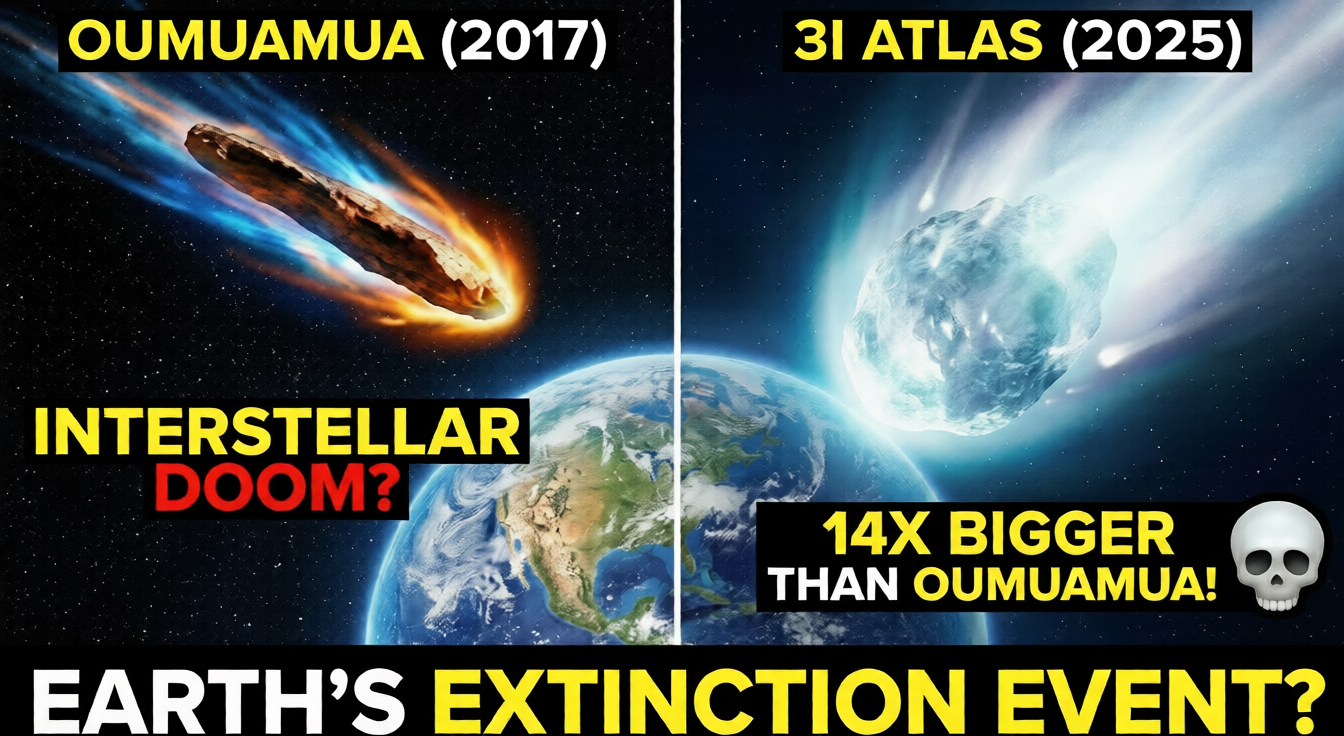
An interstellar harbinger of doom racing through our solar system could carve a crater the size of a city, vaporizing everything in its vicinity. That odd cigar-shaped asteroid is 'Oumuamua—the first interstellar rock on record. Interstellar, which means it came to us from outside the solar system. And the sheer force of a collision with this rock would be devastating.
But as far as interstellar rocks go, 'Oumuamua is not the worst. Meet comet 3I/ATLAS. While 'Oumuamua is big, 3I/ATLAS might be 14 times bigger, which means 14 times the impact, 14 times the crater, 14 times the vaporization—or more.
A collision with this rock would release the same kind of energy that a certain other asteroid did 66 million years ago, ending the reign of the dinosaurs and killing nearly everything on Earth. This means that if 3I/ATLAS struck Earth today, we're talking about an extinction-level event.
Understanding Our First Interstellar Visitor: 'Oumuamua
Now, to better understand 3I/ATLAS, let's take another look at 'Oumuamua. Like I said, 'Oumuamua was the first object we've ever confirmed to be visiting us from outside of our solar system. Roughly translated from Hawaiian, 'Oumuamua means "a messenger from afar arriving first," which is quite fitting because it's literally from afar arriving first, at least to us Earthlings.
And while scientists have theorized about the existence of interstellar visitors for decades, 'Oumuamua is undeniably from another star system. How do we know? Because it was moving way too fast to be local. Most of the local comets and asteroids in our solar system move about 20 kilometers per second. That's 12 miles per second. Yeah, that's incredibly fast.
But 'Oumuamua is moving so much faster. When it left the solar system, it moved at 87 km/s (54 miles per second). Don't worry, it won't actually hit Earth ever. Yeah. No. Scientists ran the numbers and realized that 'Oumuamua is not moving into our neighborhood. It came from deep space, cut through our solar system, and it's returning to deep space.
The First Interstellar Classification
Scientists have named it 1I/2017 U1, giving the object a whole new classification. The number one means it's a first, and the "I" stands for interstellar. And though we suspect that there's always one of these objects somewhere in the solar system, we don't find them very often.
The potential planet buster 3I/ATLAS was only discovered in 2025. Meaning, that's right, it's just the third interstellar object we've ever discovered in the solar system.
'Oumuamua's Unusual Characteristics
But what's weird about 'Oumuamua, besides the fact that it originated from deep space, is that it's shaped like a cigar. We just don't have these long cylindrical shaped objects flying around our planetary neighborhood. The asteroids and comets in our solar system are usually potato-shaped, but 'Oumuamua is 10 times longer than it is wide, and it spins around on multiple axes.
This has led to all kinds of speculation and excitement. Some scientists theorize that it may have been made by aliens. Maybe it was a probe or an alien-made ship. Part of that speculation was driven by 'Oumuamua's inexplicable acceleration. Yeah, it was moving faster than it should have been.
Those same scientists initially suggested it may have been due to an alien light sail or solar sail, a type of spaceship drive that relies on the force of star radiation. Spaceships with solar sails aren't science fiction, though they're rare. Humans have successfully launched solar sail-powered spacecraft, too.
Still, most scientists don't agree with the idea that our first verified interstellar visitor is an alien probe. They studied the interstellar voyager and concluded that 'Oumuamua is more likely just a comet—a comet that doesn't play by our solar system's usual rules in that it's never shown one of those famous comet tails, but it's a comet all the same.
This means that its extra acceleration is likely due to some kind of hydrogen outgassing. Since it was discovered near Jupiter's orbit, 'Oumuamua has already shot by Saturn and Neptune and is now headed for the constellation Pegasus. It's been traveling through space for hundreds of millions of years, and it'll be hurtling through the expanse for another 100 million years or more.
3I/ATLAS: A More Ancient and Dangerous Visitor
But that's nothing compared to how long 3I/ATLAS may have been around. There's a good chance that as weird and mysterious as 'Oumuamua was, 3I/ATLAS could be even more intriguing.
First off, 3I/ATLAS is from a very different part of space than 'Oumuamua. It looks like 3I/ATLAS originated in the Milky Way's thick disc of stars, which means there's a high chance that 3I/ATLAS is older than our solar system and quite possibly billions of years older, born in a region of primeval stars formed in an ultraviolent era of the galaxy's past.
An Unprecedented Ancient Object
While every object in our solar system is a maximum age of 4.5 billion years, 3I/ATLAS could easily be 7 billion years old or more. This may be the oldest object we've ever observed in our solar system. It also means that this space rock has a completely different makeup than any other object we've ever witnessed.
For example, scientists think there are high levels of nickel and iron in the gases surrounding the comet, which researchers say is extremely puzzling. All I know is it's metal, which won't be good news when it plows into Earth at 61 kilometers per second.
3I/ATLAS also has water and carbon dioxide ice blasting out of it. So unlike 'Oumuamua, it has that typical coma—the envelope of gas and dust—and the tail associated with most comets. The Hubble Space Telescope picked up a shot of 3I/ATLAS in July of 2025, showing off that characteristic halo of dust surrounding the comet's icy nucleus.
The closer it gets to our sun, the more distinct and explosive the coma and tail will get. And it's going to get close to the sun.
Current Trajectory and Size
The good news is it's not going to hit the Earth. At its closest point in December of 2025, 3I/ATLAS will still be 1.8 astronomical units from our pale blue dot. That's still 270 million kilometers (170 million miles) off base. But on an astronomical scale, it's not that far off.
3I/ATLAS is still going to pass within Mars's orbit and miss it by just 28 million kilometers (18 million miles). That's less than a quarter of the distance from Earth to Mars.
Now, because this comet is still pretty far, scientists are still working to nail down the exact size of it. NASA determined that it's a minimum of 440 meters in diameter (1,444 feet), and a maximum of 5.6 kilometers in diameter (3.5 miles).
For dramatic purposes, let's theorize to the max: 3I/ATLAS being 5.6 kilometers wide when it hits us.
The Hypothetical Impact Scenario
Now to the part of the story you've been waiting for—the impact. Let's say 3I/ATLAS's angle of approach was slightly different as it entered our solar system. And what if we discovered it too late and it arrived on our celestial doorstep before we could figure out how to deflect something in orbit?
Total mayhem, right? So, what if 3I/ATLAS struck Earth instead of passing by harmlessly?
Comparing to the Chicxulub Impact
Well, to answer this, we have to go back to the planet buster, Chicxulub. This iconic asteroid struck Earth 66 million years ago. It devastated the planet and completely changed the history of life on Earth. So, yeah, spoiler alert. If 3I/ATLAS hit us, it would not be pretty.
Now, 3I/ATLAS is a massive comet, but it's only about half the size of the 10-kilometer-wide Chicxulub asteroid. The Chicxulub impactor was mostly a carbonaceous asteroid made up of a mix of rock, minerals, metals, and some carbon compounds. 3I/ATLAS is mostly made of carbon dioxide ices and metal.
The Speed Factor Changes Everything
So, let's say they have similar densities, but there's a concerning difference. 3I/ATLAS is traveling way faster. Chicxulub was moving at about 20 km/s when it hit us. 3I/ATLAS is moving at 61 km/s at its slowest and would speed up as it approached the sun.
That kind of velocity would be a huge problem for Earth. Because the faster an asteroid moves, the deadlier the impact. So even though 3I/ATLAS is smaller and lighter than Chicxulub, because of its speed, it would hit Earth with 4.5 times the energy of Chicxulub and would do way more damage.
Three simple words. Say them with me now. Extinction level event.
The Immediate Devastation
When Chicxulub hit Earth 66 million years ago, it carved a crater 100 kilometers wide (62 miles wide) and 30 kilometers deep. The blast radius incinerated everything within 1,500 kilometers, caused extremely high tsunamis across the planet, and ended 70% of the flora and fauna on Earth.
3I/ATLAS would hit harder. Yeah, it would punch right through the atmosphere, then slam into Earth's crust in just over one second.
The Impact Sequence
A superheated core of plasma would cremate everything near the point of impact. A 3I/ATLAS strike would produce a shock wave thousands of kilometers across whatever ocean or continent it struck.
If it struck near a land mass like Chicxulub did, it would create super hurricane-level winds, talking at speeds of 1,000 kilometers per hour. These are hurricanes that would destroy forests and cities.
And the blast would launch trillions of tons of molten material into the atmosphere, burn every tree on the continent, and set every forest on the planet on fire.
Tsunamis and Global Destruction
Then cue the tsunamis. High waves would flood the continents, moving 100 kilometers inland. Rubble would fall from the sky and land would slide into the sea. Everything on the side of the planet that was struck would be toast.
After that, the impact would cause worldwide earthquakes that register beyond the Richter scale, volcanic eruptions, and even more tsunamis.
The Long-Term Catastrophe
And then after the fires burned out, things would get real quiet, but not in a good way. The immediate effects of the 3I/ATLAS impact would be devastating, but the real planet killer effects are the long-term consequences.
Nuclear Winter
When an asteroid or a comet of that size blasts that much magma, water vapor, silt, and dirt into the atmosphere, it blocks the sunlight. For years, maybe even decades. The sky would go dark. It would get cold. Nuclear winter cold.
Photosynthesis would stop. Plants would die. And everything that fed on plants would be gone, too. All the debris in the atmosphere would rain down on the Earth as extreme acid rain.
Any terrestrial or freshwater vegetation that wasn't already burnt, frozen, or dying from lack of sunlight would fry under this rain. That would add to the collapse of the food chain.
So unless you had a real deep bunker loaded with cases of canned beans, you and every animal that survived the initial disaster would starve to death.
Environmental Collapse
The planet would also face the destruction of the ozone layer and even toxic metal poisoning from all the material raining back down on it.
Now once that all settled, after a few years, things might actually start to get hot. That's because since 3I/ATLAS is made of carbon dioxide ice, all that ice would vaporize when the comet hit the ground.
But Earth wouldn't heat up right away. Only much later when the skies finally clear would the leftover carbon dioxide start trapping heat and push the climate back in the other direction.
So, first a deep freeze, then a long scorching recovery. Not that you'd be able to witness any of it because you wouldn't be alive.
The Verdict: Global Mass Extinction
In short, if 3I/ATLAS struck Earth, it would be a global mass extinction. Enormous loss of life, species, entire countries, and continents. It would probably be a good time to be on the International Space Station, though getting back home might be a problem after all the Armageddon.
The Silver Lining
Now, the good news is, like I said, 3I/ATLAS isn't actually going to come anywhere near us. But it's a little sad because studying this older-than-the-solar-system comet up close would be huge. Telescopes on Earth don't have a great angle on it against the sun to be able to study it from a distance.
So, you shouldn't look at this comet as a harbinger of doom, but rather an opportunity to look back in time and space before the solar system, our sun, and Earth were even born.
3I/ATLAS represents a fascinating window into the ancient cosmos—a messenger from the primordial galaxy that formed billions of years before our own solar system existed. While its hypothetical impact would spell disaster for life on Earth, its actual passage through our solar system offers scientists an unprecedented opportunity to study the building blocks of the early universe.
The comet serves as a reminder of both the fragility of life on Earth and the incredible forces that have shaped our cosmic neighborhood throughout billions of years of galactic evolution.