
- Published on
What If The Largest Objects in the Universe Collided?
- Authors

- Name
- FeelTheShock
- @FeelTheShock
This is our sun, our solar system, all the way out to the orbit of Neptune, the most distant planet from the sun. And here's the heliopause, which is the edge of the sun's solar wind and the beginning of interstellar space. And this humongous thing is the supermassive black hole known as TON 618. It's about 40 billion times the mass of our sun.
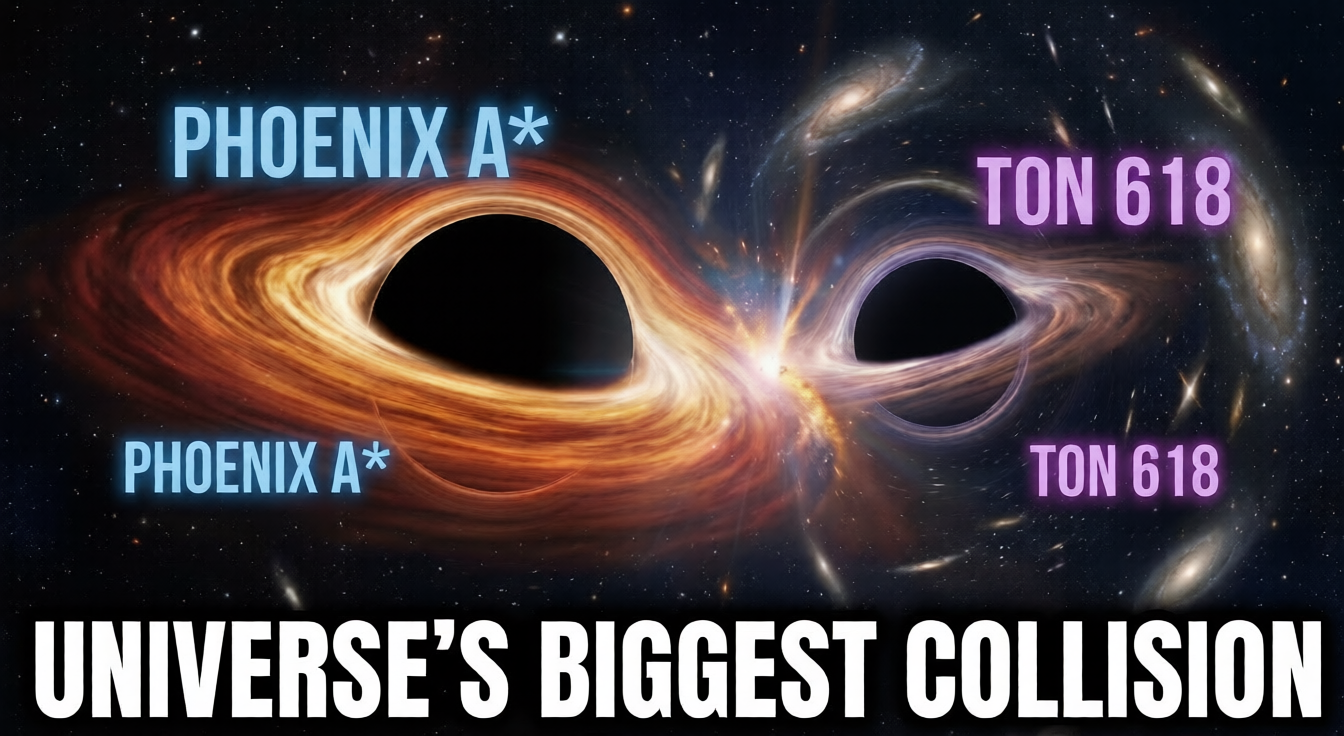
And if you think that's huge, well, think again because this is Phoenix A*, an absolute behemoth of a black hole, 100 billion times the mass of our sun. So, what would happen if these two collided? Let's smash big things into each other. I mean, why stop at smashing two gargantuan black holes when you can do the same with the most massive stars, the largest planets, and even two galaxies. It's going to get explosive.
Understanding Black Hole Sizes
We'll start with the black holes. Now, to really get past the event horizon of just what happens when black holes collide, it helps to understand just how big they are. On the smallest end of the scale are stellar mass black holes. These are the remnants of huge stars that have burned through their hydrogen and helium and collapsed in on themselves. Their inescapably dense bodies will swallow anything that drifts by, including light.
A stellar mass black hole can be smaller than the moon in size, but 100 times more massive than our sun. Now, on the other side of this scale, supermassive black holes lurk at the center of most galaxies.
The Black Hole Scale
To give you a fuller sense of their scale, let's compare the sun to one of the smallest supermassive black holes out there, J1601+3113. It looks like it's roughly the same diameter as the sun, but that little guy is 100,000 times more massive.
Now, if we were to travel to the Perseus galaxy, we'd find a black hole weighing more than 1 million suns. This one would barely be able to squeeze between the orbits of Venus and Earth. Now, closer to home, in the middle of our own Milky Way, is Sagittarius A* with a mass of 4.3 million suns. You get the idea. Black holes are massive.
But these black holes are positively puny compared to the black hole in the center of Cygnus A, the most powerful source of radio waves in the universe. It dwarfs our entire solar system, generating unbelievable amounts of energy while it consumes endless amounts of space-borne material. This monster weighs in at over 2 billion suns.
But it's not the largest object out there. M87*, the first black hole to be imaged directly, weighs over 6.5 billion suns. And all of them are just bugs compared to TON 618. The supermassive black hole so large it would engulf our solar system beyond the furthest reaches of our unexplored Oort Cloud. TON 618 has a mass of over 66 billion suns.
Phoenix A*: The Ultimate Champion
You'd think it's an absolute monster, a true contender for the heavyweight championship belt, but it's not because scientists have found Phoenix A* about 8 billion light-years away from us. This thing is ancient. Black holes this big didn't just happen because a star ran out of helium last month.
Black holes like this could be primordial—some of the first black holes forged after the Big Bang. And it's growing, devouring an entire sun's worth of mass every week.
When Supermassive Black Holes Collide
So, what would happen if TON 618 collided with the black hole at the center of Phoenix A? Well, they would send ripples through spacetime. But don't imagine their collision like a car crash. This would be a dance.
Put these two Leviathans in the same galaxy and they would start to circle slowly. Over millions of years, they'd spiral toward each other, drawn by the undeniable power of gravity. Two singularities which, once they pass a certain point, are bound to each other forever.
They would fall into an ever-tightening orbit until they're infinitely close and still infinitely far. They may do this for eons and then they reach a critical distance. The black holes begin to distort each other's shape. For an instant, they're two shapeless voids morphing, stretching toward each other in the emptiness of space.
The Cosmic Merger
After millennia, when they finally touch, the long-anticipated connection happens fast. And then an incalculable cosmic bloop. That's right, bloop. Two of the largest objects in the universe combined to make one. One stupendous, supermassive black hole, bigger and more massive than anything we can conceive.
Hundreds of billions of solar masses merging, sending out so much energy, it shimmers across the universe in the form of gravitational waves for billions of years. And then they go on consuming everything in their path like nothing big happened. Though something big definitely happened.
Galactic Collisions: When Entire Star Systems Merge
Now, what else is out there in the universe colliding that's even bigger than a black hole? Well, how about an entire galaxy? Now, we know that there are entire galactic clusters out there like El Gordo smashing into each other with incredible violence. It happens more often than you want to imagine.
And it's going to happen to our own galaxy, the Milky Way. Yeah. In about 5 billion years, we're going to collide with the nearby Andromeda galaxy.
The Andromeda Collision
So, what happens when two galaxies smash into each other? Well, if black holes colliding looks like soap bubbles popping, then two galaxies colliding is more like two ghosts running into each other in the hall. I know that sounds crazy, but stay with me here. It's a pretty good metaphor.
Galactic mergers are a process that takes billions of years, fueled by the power of gravity. Right now, gravity is already pulling the Milky Way and the Andromeda galaxy toward each other. And even though they won't make contact for nearly 4 billion years, the two galaxies are being drawn together across millions of light-years of open space.
The Merger Process
Eventually, they'll collide. Stars torn from their regular orbits, ripped apart by extreme tidal forces. Dust and gas scattered everywhere. For the Milky Way, a large barred spiral galaxy with over 100 billion stars, its long whirling arms will shiver and distend.
Both galaxies will warp and distort. The forces of the collision tearing apart those billion-year-old spirals. As they loop back toward each other, they'll lose their shape and eventually they collide—or well, merge. Stars will be scattered and redistributed throughout the body of a much larger brand new galaxy.
And the black holes at the center of the galaxies, remember Sagittarius A*? Well, at some point they'll bloop together.
Why It's Like Ghosts Colliding
Now, while it looks cataclysmic, remember when I said it was more like two ghosts hitting each other? Well, that's because most of the billions of stars involved in the collision won't hit each other. There are hardly any casualties. Space is big.
And although there are more than 100 billion stars in each galaxy, they're an average of five whole light-years apart. That's an average of 47 trillion kilometers, 29 trillion miles between each star. So, while the merger of a trillion superheated balls of glowing plasma rearranging themselves is a spectacular billion-year event, it's actually a comparatively non-destructive process.
It'll be rare if any stars or planets hit each other. It does happen, and we'll talk about that in a minute, but mostly it's like two ghosts passing in the hall. See?
Giant Planet Collisions: The Sumo Wrestlers of Space
Now, what if some of the stars or giant planets in those galaxies—or any galaxy really—did hit each other? Well, that gets very interesting. Let's talk about giant planets colliding first.
The biggest planets are gas giants like the jumbo gas giant in our solar system, Jupiter. And while Jupiter is a huge planet and you could fit over a thousand Earths inside it, it's far from being the largest planet out there.
The Heavyweight Contenders
In just the last couple of decades, scientists have discovered two of the absolutely chunkiest gas giant planets in the universe. Naturally, we wondered what would happen if those two big boys smashed into each other. These are the sumo wrestlers.
In this corner, WASP-17b, an extremely young gas giant, roughly the same diameter as Jupiter, but 9 times more massive. And on the other side of the ring, TOI-4603b, almost the same radius, but weighs in with a planetary mass of 12.89 Jupiters. That is a lot of Jupiters. This massive planet is almost massive enough to be a sort of star.
The Ultimate Planetary Collision
So, what happens if they run into each other? Well, it starts out simple enough. These two Titans crash into each other at typical solar system speeds. They're made of helium and hydrogen. They're gas giants. It's the biggest wump in history.
Sure, all kinds of gas and liquid hydrogen blast into space, but in short, these two giant gas bags plow into each other and merge. And that's when something interesting happens. The two planets become one entity and tip the scales beyond what's actually a planet.
They blast past the critical weight limit of 13 Jupiters and enter into new territory. They become a brown dwarf. Not quite a planet anymore, not quite a star.
Birth of a Brown Dwarf
These twins of the universe have masses between 13 and 80 times Jupiter's mass. Some call them failed stars because they don't have the necessary mass to ignite nuclear fusion with hydrogen, but they do have enough mass to ignite nuclear fusion with deuterium atoms.
So, they don't quite shine, but they often generate their own heat and glow. Not with light visible to the human eye, but with infrared light.
Now, it's possible that if these brown dwarfs draw in enough mass or bump into another planet or two, they'll cross the 80 Jupiter masses line and eventually turn into stars. But in the moments after they collide, our planetary wrestlers become a brand spanking new brown dwarf.
Stellar Collisions: When Stars Go to War
Now speaking of stars, what would happen if two stars collided? I'm not just talking tiny stars that barely cross the threshold to stardom. How about mega stars?
Stars like BAT99-98, a colossal star in the Tarantula Nebula with a mass over 200 times the mass of our sun and 5 million times brighter. This thing is hot, young, and pumping out the energy, burning through mass. It's bound to go supernova sooner or later.
It's so big that if we replaced our sun with it, we'd basically all go blind immediately. The radiation and solar wind would strip all life off planet Earth, evaporate the oceans, and melt the Earth's crust before its gravity pulled us into a plunge orbit and swallowed our planet whole within a handful of days. It's huge.
The Contenders: BAT99-98 vs Eta Carinae
It's similar in stature to Eta Carinae out in the Homunculus Nebula. Carinae is actually a binary star pair, but the big sibling is Carinae A, a luminous blue star. It's so big and burning so much energy that it's actually destroying the nebula around it. It's the only known star to produce an ultraviolet astrophysical laser. Yeah, a laser.
So, what would happen if these two intensely energetic stars collided? Trust me, this is not a dance or ghosts in the hall or a cosmic bloop. This will get explosive.
Two Possible Outcomes
There are basically two things that can happen. Now, if the stars impact each other at a slow enough velocity, say one sidles up beside the other, well, then they'll casually merge, creating a new, even brighter, more luminous star called a blue straggler, which offhand is a great name for a blues band.
Out in the real universe, a blue straggler is an extremely bright blue star that stands apart from the rest of the stars in its neighboring star cluster. It acts young because it's chock full of fuel compared to the nearby older stars reaching the end of their lives, turning into red giants.
So, if these two Brontosaurus-sized stars bumbled into each other, they'd essentially turn into one larger, brighter, bluer star.
High-Velocity Catastrophe
But what happens if they don't just amble up on each other? What if BAT99-98 and Carinae, two of the biggest stars in the universe, wound up in a head-on high-velocity autobahn-style collision?
Imagine Carinae A tearing through the Tarantula Nebula on a high-speed collision course. It closes on BAT99-98, gravity pulling them toward each other at incredible speeds. And when they finally collide, the collision causes a cataclysmic explosion so huge, so devastating, the impact completely obliterates both stars, destroying them entirely.
The speed and power of the impact spraying star guts—or hydrogen as we call it—so far over interstellar space that it'll never be able to reform. Complete annihilation. No woomph, no bloop, just complete savage havoc that wipes both stars off the celestial map.
Now that's a collision.
The Ultimate Cosmic Showdown
From the delicate dance of merging black holes to the ghostly passage of colliding galaxies, from the birth of brown dwarfs in planetary collisions to the complete annihilation of massive stars, the universe stages the most spectacular crashes imaginable.
These cosmic collisions reshape the very fabric of space and time, creating gravitational waves that ripple across billions of light-years, forging new celestial objects, and sometimes destroying them entirely. In a universe where everything is in motion, these titanic encounters remind us of the incredible forces at play in the cosmic arena.
Whether it's a gentle merger or complete obliteration, when the largest objects in the universe collide, they create some of the most awe-inspiring spectacles in all of existence.